
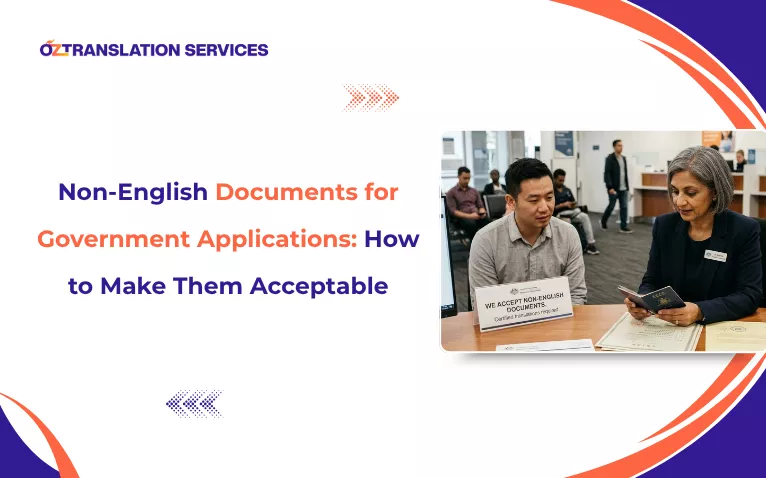
People who are migrating to Australia must submit their government-issued personal documents, along with legal, financial, and academic documents. When any foreign document is not in English, it must be translated for government applications and other official purposes. In this guide, we will discuss how to make non-English documents for government applications acceptable to Australian authorities in detail.
Table of Contents
ToggleKey Takeaways for Non-English Documents for Government Applications
- Foreign Documents that are in a language other than English need an English translation to lodge any official applications with Australian government agencies.
- The process of making non-English documents valid for official use or government applications involves certified translation done by an NAATI-credentialed translator.
- Official use of foreign language documents for high-risk legal cases or court proceedings often need Notarisation of the translated document.
- Meeting foreign language document requirements for government applications is non-negotiable, or applicants may face delays, visa rejection, legal repercussions, and unnecessary expenses due to restarting the process.
- Translating non-English documents for official use can be easily done online from websites like OZTranslationServices.
How Can Non-English Documents Be Made Acceptable for a Government Application?
The straight answer is that non-English documents must be translated into English to make them acceptable for government applications. The Australian official framework is English-centric; therefore, English translations are mandatory. Furthermore, only certified translations done by a NAATI translator are accepted for Australian usage.
What Are the Non-English Document Translation Requirements?

The primary requirement for government accepted document translation is that it must be certified. Now, what do we mean by certified translation for non-English documents?
These are basically officially stamped translated documents that are signed by an accredited translator from the National Accreditation Authority for Translators and Interpreters. Earlier, this used to be a wet-ink stamp with the translator’s ID number.
From March 2023, NAATI released digital identification as an option; practitioners can choose either a physical stamp/ID card or the digital QR, which is downloaded from the translator’s registered NAATI account. This is a form of traceable authentication that signifies:
- Professional accountability for the translated document’s genuineness
- That the translation is valid, accurate, and a true replica of the original document.
- The translated document is legally valid for official purposes.
Apart from the stamp, the certified document must have:
- The full name of the translator
- Date of translation
- Unique practitioner ID
- Specific language pair (e.g., Mandarin Chinese to English)
- Credential status
Partial translations (e.g. only names and dates) are routinely rejected; full translations of documents, including stamps/seals/issuing authority details is mandatory.
Important Note: DIY translations as well as documents translated by colleagues, friends, family members, online tools (e.g., Google Translate), or AI tools (e.g., ChatGPT) are outright rejected. The need for NAATI accreditation is critical to meet Australian government requirements.
Do Visa Applications Usually Require Certified Translation Services for Non-English Documents?

Yes! The Australian Department of Home Affairs asks for a certified translation of non-English documents to process visa applications. Whether you are applying for an Australian work visa or a family visa, you need to translate your Visa and Passport as well as other supporting documents, like:
- Birth Certificate Translation
- Marriage Certificate translation
- Bank statement Translation
- Death Certificate Translation
- Driver’s License Translation
- Police Clearance Certificate Translation
- National ID Card Translation
If you are a student applying for a visa, then you also have to get a certified translation of your academic transcript, diploma, and degree.
While translating non-English documents for visa applications, always check the guidelines specified for respective pathways and arrange the documents accordingly. Contact your Embassy or Consulate to know the exact list of documents required for a visa grant.
Do Non-English Documents Require Notarised Translation for Government Applications?
Many people face confusion between choosing certified vs notarised translation.
While in Australia, certified translation of non-English documents is enough, notarised translation is generally needed for certain cases. These include court proceedings or submitting documents from a high-risk jurisdiction.
In these cases, the certified translators sign the translations in the presence of a registered Notary officer. Please note that the Notary officer will only witness and verify the person signing the translation. Their job doesn’t include checking the translation’s accuracy.
How to Get Started with Non-English Document Translation to Meet Australian Government Standards?

You can easily get started with the online translation process to make non-English documents acceptable for government applications. Here’s the step:
Step 1: Find a Reliable Provider
Find a translation service website that works with NAATI-recognised translators.
Step 2: Prepare Your Documents
Gather all the original, non-English documents and produce high-quality digital scans of each. Save them in PDF format and name them accordingly to avoid confusion. If your paperwork includes foreign legal authentications or seals, securing a certified translation for apostille documents during this step ensures that both the primary certificate and its official authentication stamps are fully accepted by government authorities.
Step 3: Upload the Documents and Place Online Order
Online translation service providers generally have an easy-to-order framework. You have to upload the PDF files of the original documents through an online form while also specifying the language pair and required delivery timeline.
Some providers also offer 48-hour urgent and 24-hour same-day delivery options. These may charge extra. Also, if you need postal delivery of the hard copy, check if such a service is available. For physical delivery, the delivery timeline varies.
Lastly, pay the quoted price for translation to confirm the order. Certified translations in Australia generally cost A$ 60 per page, but the final quote is subject to change as per language pair, chosen delivery timeline, and number of pages.
Step 4: Get the First Draft and Review
Professional translation service providers often send you the first draft for review before certifying it. Check it thoroughly from your end and send for finalisation or request a correction/edit/revision if required.
Step 5: Get Your Non-English Documents Translated and Certified for Government Applications
You will generally get the final certified translation within the requested timeframe. The delivery mode is often a PDF file, which can be directly uploaded to the respective sites of your specific government application.
Important Note: As per the requirements for submitting foreign language documents to government applications, you also need to attach your original documents along with the translation. Before you submit, it is worth checking for mistakes to avoid in government translation — most rejections come down to a handful of avoidable errors rather than translation quality.
Need High-quality, Government-Approved Translations? Contact us!
Get your non-English documents translated right the first time by choosing OZTranslationServices. The translated documents are NAATI-certified and compliant for official use in Australia. Choose any language pair among our available 150+ options, including Spanish, Arabic, French, etc., with standard and same-day delivery options. All types of documents, from personal, financial, to legal and business, are translated with precision and accuracy. Order now or request a free quote.
Frequently Asked Questions
Do I need an apostille for translated documents?
An apostille is needed when an Australian-issued document is used in another Convention country (or vice versa). It’s not required for documents used domestically within Australia.
If you are in the first scenario, you have to get your original document apostilled first. Then the whole package (original document and the apostille certificate) will be translated.
Is online notarised translation possible for non-English documents?
Yes, the translation of non-English documents can be notarised online, and it is legally recognised in Australia. The entire notarisation process takes place through a scheduled video-conferencing platform where the NAATI translator and the notary office join to fulfil the authentication. This is also popularly known as a video-notarisation service.
How to submit the translation of non-English documents to the Australian Department of Home Affairs?
You can upload the PDFs of translations along with original documents directly to DHA’s immAccount portal, following the given instructions.
Can a translator correct a spelling error or a wrong date of birth found in my original non-English document?
No. The NAATI translator’s legal obligation is to represent the source document in a “true and accurate” manner. They will not “correct” or “edit” information, such as a misspelled name or a wrong date, regardless of the evidence you may give, if they believe that information is incorrect. If there is an error in your original document, you need to rectify the error with your issuing country before translating it. If this is not feasible, a Statutory Declaration, along with the translation, may be required that details the discrepancy to the government agency.

- DFAT Authentication vs Apostille in Australia: Which Certificate Do You Need? - September 9, 2026
- Communicating with Aboriginal and Torres Strait Islander Communities - August 4, 2026
- Community Checking in Translation: Testing Translations before Launch - July 28, 2026