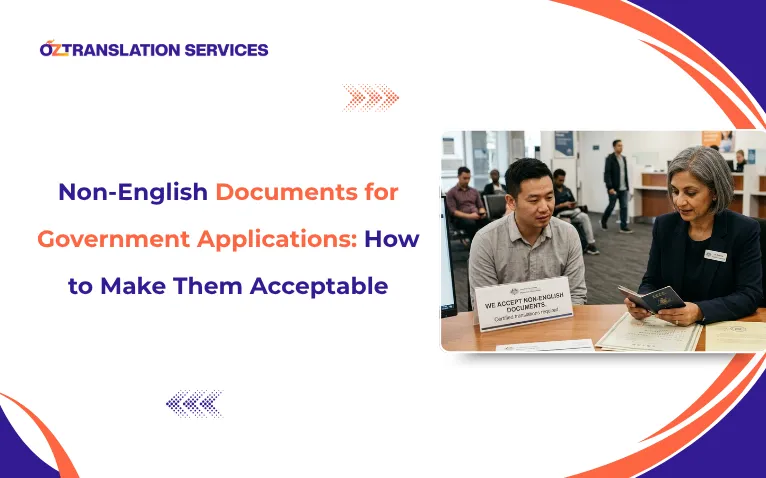
People migrating to Australia usually need to submit personal documents and, depending on the visa, legal, financial or academic documents. When any foreign document is not in English, it must be translated for government applications and other official purposes. In this guide, we explain in detail how to make non-English documents for government applications acceptable to Australian authorities.
Table of Contents
ToggleKey Takeaways for Non-English Documents for Government Applications
- Foreign documents in a language other than English need an English translation before you can lodge official applications with Australian government agencies.
- To make non-English documents valid for official use or government applications, you need a certified translation by a NAATI-credentialed translator if the translation is done in Australia.
- Notarisation is needed only in some cases, such as certain legal proceedings or documents for use overseas.
- Meeting foreign-language document requirements for government applications is non-negotiable; otherwise, applicants may face delays, visa refusal, and the cost of restarting the process.
- You can easily translate non-English documents for official use online through services like OZTranslationServices.
How Can Non-English Documents Be Made Acceptable for a Government Application?
In short, non-English documents must be translated into English to be acceptable for government applications. The Australian official framework is English-centric; therefore, English translations are mandatory. For applications completed in Australia, translations must be completed by a NAATI translator.
What Are the Non-English Document Translation Requirements?

The primary requirement for government-accepted document translation is certification. Now, what do we mean by certified translation for non-English documents?
These are officially stamped translated documents that are signed by a translator credentialed by the National Accreditation Authority for Translators and Interpreters (NAATI). They have a wet-ink stamp with the translator’s ID number. In March 2023, NAATI introduced a digital stamp with a unique QR code, downloaded from the translator’s myNAATI account. This is a form of traceable authentication that signifies:
- The translator’s professional accountability for the translation.
- That the translation is a complete and accurate rendering of the original.
- That the translator’s NAATI credential was current at the time of certification.
Apart from the stamp, the certified document must have:
- The full name of the translator
- Date of translation
- Unique practitioner ID
- Specific language pair (e.g., Mandarin Chinese to English)
- Credential type
Partial translations (e.g. only names and dates) may not be accepted; the full document, including stamps, seals and issuing authority details, should be translated.
Important Note: DIY translations as well as documents translated by colleagues, friends, family members, online tools (e.g., Google Translate), or AI tools (e.g., ChatGPT) are not accepted for translations completed in Australia. NAATI accreditation is critical to meet Australian government requirements.
Do Visa Applications Usually Require Certified Translation Services for Non-English Documents?

Yes! The Australian Department of Home Affairs requires certified translations of non-English documents to process visa applications. Whether you are applying for an Australian work visa or a family visa, you need certified translation for government applications of any supporting documents not in English, like:
- Birth Certificate Translation
- Marriage Certificate Translation
- Bank Statement Translation
- Death Certificate Translation
- Driver’s Licence Translation
- Police Clearance Certificate Translation
- National ID Card Translation
If you are a student applying for a visa, you also need a certified translation of your academic transcript, diploma, and degree.
When translating non-English documents for visa applications, check the document checklist for your visa subclass on the Department of Home Affairs website.
Do Non-English Documents Require Notarised Translation for Government Applications?
Many people are confused about whether to choose certified or notarised translation.
In Australia, certified translation of non-English documents is usually enough, but notarisation may be requested in certain cases, such as some legal proceedings or documents for use overseas.
In these cases, the certified translator signs the translation in the presence of a notary public. A notary public only witnesses the translator’s signature and verifies their identity. They do not check the translation’s accuracy.
How to Get Started with Non-English Document Translation to Meet Australian Government Standards?

You can get started with online translation to make non-English documents acceptable for government applications. Here are the steps:
Step 1: Find a Reliable Provider
Find a translation service website that works with NAATI-recognised translators for document translation for visa applications Australia.
Step 2: Prepare Your Documents
Gather all the original, non-English documents and produce high-quality digital scans of each. Save them in PDF format and name them accordingly to avoid confusion.
Step 3: Upload the Documents and Place an Online Order
Online translation service providers generally have a simple online ordering process. Upload the PDF files through the online form and specify the language pair and delivery timeline.
Some providers also offer 24-hour express and 12-hour urgent delivery options. These may charge extra. Also, if you need postal delivery of the hard copy, check if such a service is available. Delivery timelines vary for physical delivery.
Lastly, pay the quoted translation price to confirm the order. Certified translations in Australia start from A$60 per page, but the final quote may change based on the language pair, delivery timeline, and number of pages.
Step 4: Get the First Draft and Review
Professional translation service providers often send you the first draft for review before certifying it. Check it thoroughly from your end and send it for finalisation or request a correction/edit/revision if required.
Step 5: Get Your Non-English Documents Translated and Certified for Government Applications
You will generally get the final certified translation within the requested timeframe. Translations are usually delivered as a PDF, which you can upload directly to the relevant government portal.
Important Note: As per the requirements for submitting foreign-language documents with government applications, you also need to upload a scan of the original-language document along with the translation.
Do All Australian Government Departments Have the Same Translation Requirements?
No. The common baseline is that non-English documents must be translated into English and lodged with the original document, but departments set their own acceptance rules. NAATI advises applicants to check requirements directly with the receiving agency.
| Agency/purpose | Translation requirement |
| Department of Home Affairs — visas and citizenship | Translate all non-English documents; submit the original and translation. Translators in Australia must be NAATI-accredited; overseas translators follow separate identification requirements. |
| ATO — identity documents | Provide a certified copy of the original plus an English translation by an approved service. The translation must be certified as true and correct and should show an official stamp or similar evidence of accreditation. |
| Australian Passport Office | Documents must be translated in full by an approved translator (in Australia, find one through NAATI). If applying overseas, use a translation service approved by the nearest Australian embassy or consulate. |
| DFAT — legalisation/authentication | Requires translations by NAATI-credentialed translators in Australia. The NAATI stamp and required translator details must appear on every translated page, and a copy of the original signed/stamped by the translator must accompany the translation. |
| NSW nomination – business and investor streams | Non-English documents need a certified English translation, but full translation is not always required—translations of key pages demonstrating eligibility may suffice. |
Can You Use Translations Completed Outside Australia for Government Applications?
Often yes—but it depends on the agency. For Department of Home Affairs visa and citizenship applications, translations completed outside Australia can be accepted without NAATI certification, provided the translation includes the translator’s full name, address, phone number, and qualifications/experience in the relevant language, written in English. You must still submit the original non-English document with the translation.
For the Australian Passport Office, overseas translations are more restrictive: applicants should contact the nearest Australian embassy or consulate for a list of approved translation services, and the embassy or consulate may need to check or certify the translation. In the United States, for example, the embassy specifies ATA-certified translators; in other countries, it specifies translators approved by the local Australian mission.
DFAT’s rule is stricter: translations submitted for legalisation must be completed by NAATI-credentialed translators in Australia, with the required stamp and translator details on every page.
Common Mistakes That Can Delay Government Document Applications

Common delays come from incomplete translations, missing originals, the wrong translator credentials, and assuming one agency’s rules apply everywhere.
- Submitting only the translation. Home Affairs translation requirements says both the original non-English document and the English translation, and the Australian Taxation Office (ATO) asks for a certified copy of the original document along with the translation.
- Using a partial or extract translation. The Australian Passport Office does not accept partial translations. Stamps, seals, endorsements and annotations should be translated too.
- Omitting translator details on overseas translations. For Home Affairs applications translated outside Australia, the translation should include the translator’s full name, address, phone number, qualifications and experience.
- Using a translator without NAATI credentials in Australia. Home Affairs requires translators in Australia to be NAATI-accredited, and the ATO expects the translation to carry an official stamp showing the translator’s accreditation.
- Assuming one agency’s rules apply everywhere. DFAT requires NAATI stamp details on every translated page, and for passport applications, an Australian embassy or consulate may need to certify overseas translations.
- Not checking your specific pathway. Requirements vary by visa, citizenship, court, and licensing applications, so check the document requirements for your exact application before ordering.
Need NAATI Certified Translation Australia for Government Applications? Contact Us!
Get your non-English documents translated by NAATI-certified translators. The documents are translated by NAATI-certified translators and carry the NAATI certification that agencies such as Home Affairs require for translations done in Australia. Choose any language pair among our available 150+ options, including Spanish, Arabic, French, etc., with standard and same-day delivery options. We translate all types of documents, from personal and financial to legal and business, with precision and accuracy. Order now or request a free quote.
Frequently Asked Questions
Do I need an apostille for translated documents?
An apostille may be needed when a document is used in another Hague Convention country. The order (apostille the original first, or apostille the translation) depends on the receiving country’s rules. Check with the receiving authority before ordering.
Is online notarised translation possible for non-English documents?
Remote notarisation may be available via video link, depending on your state and the receiving authority, so confirm before booking. The entire notarisation process takes place through a scheduled video-conferencing platform where the NAATI translator and the notary public join to fulfil the authentication. This is also popularly known as a video-notarisation service.
How do I submit translations of non-English documents to the Australian Department of Home Affairs?
You can upload PDF translations and the original documents directly to Home Affairs’ ImmiAccount portal, following the instructions.
Can a translator correct a spelling error or an incorrect date of birth in my original non-English document?
No. The NAATI translator’s legal obligation is to represent the source document in a “true and accurate” manner. They will not “correct” or “edit” information, such as a misspelt name or a wrong date, even if you provide evidence that it is incorrect. If there is an error in your original document, you need to rectify the error with the issuing authority before translating it. If this isn’t feasible, you may be asked to provide a statutory declaration or other evidence explaining the discrepancy.
Do translations of non-English documents expire in Australia?
Generally no. If the original is reissued or changed, you need a new translation, and some agencies set their own conditions, so check before reusing an older translation.
Can I use the same NAATI translation for multiple government applications?
Yes. However, before you submit the translation, please check the receiving authority’s exact requirements.
Will Australian government agencies accept digitally certified translations?
Most do, but not all. NAATI has noted that some organisations, including ASIC, have not accepted the digital stamp, so check with the receiving agency first.
What should I do if my translated name does not match my passport?
If your translated name doesn’t match your passport, first check the spelling in your original document. If the original differs from your passport, have the issuing authority correct it, or ask the receiving agency what supporting evidence it accepts.
Which other government bodies need translations?
Most authorities and government bodies need translations of foreign documents. However, do check the foreign language document requirements Australia before submitting the translated documents.
What if no NAATI-certified translator exists for my language?
If NAATI doesn’t offer certification testing in your language, look for a translator who holds the NAATI Recognised Practising credential.

- Non-English Documents for Government Applications: How to Make Them Acceptable - October 26, 2026
- How to Get Your Documents Translated If NAATI Doesn’t Certify Your Language - October 13, 2026
- DFAT Authentication vs Apostille in Australia: Which Certificate Do You Need? - September 9, 2026