


Are you a business professional or an individual getting financial translations for your reports to tap into the new market? Have you been struggling to find the best translator to accurately and precisely translate your financial documents and reports?
Table of Contents
ToggleIf so, then this blog is for you. From its technical definition and its importance, to how to translate it and the associated costs, we have covered it all. Furthermore, we will share 10 essential tips for your financial translation to ensure accuracy and precision.
What Is Financial Translation?
Financial translation is a specialised process that involves translating intricate financial documents, such as balance sheets, audit reports, and income statements, from the source language to the target language. Unlike general word-for-word translation, financial bank statement translation requires a blend of linguistic mastery and deep financial expertise to preserve the essence of high-stakes financial terminology, ensure accuracy, and maintain compliance with diverse international regulations.
Why Financial Translations Are Important for Your Business?
For companies operating globally, accurate financial translation is a vital tool that bridges linguistic divides, fosters trust with stakeholders, facilitates informed decision-making, and enables expansion into new markets. Without it, businesses face risks like misinterpreting regulations, compliance issues, financial losses, and damage to their reputation.
Now, let’s review the 10 essential tips for financial translations, which will not only help you understand the challenges but also guide you in choosing the right service for the accurate translation of financial documents.
What Does Financial Translation Include?
Here are the types of financial document translation and topics across diverse industries:
• Core Financial Documents
◦ Balance sheets
◦ Audit reports
◦ Income statements
◦ Annual reports
◦ Financial statements
◦ Expense reports
◦ Invoices
◦ Tax reports
◦ Contracts
◦ Property listings
◦ Prospectus reports (on bonds, mutual funds, equities)
◦ Shareholder communications
• Key Financial Areas and Topics
◦ Accounting reports
◦ Banking
◦ Investments
◦ Insurance (including policies, financial statements, and compliance documentation)
◦ Taxes (including specific tax regulations of the region)
◦ Mergers and acquisitions
◦ Corporate governance
◦ Compliance reporting and regulatory filings
◦ Supply chain documents
◦ Operational jargon
• Other Related Materials
◦ Verbal presentations and conferences related to sensitive financial information
◦ Any business documents meant for international audiences
What Are the Essential Tips for Ensuring High-quality Financial Translations?
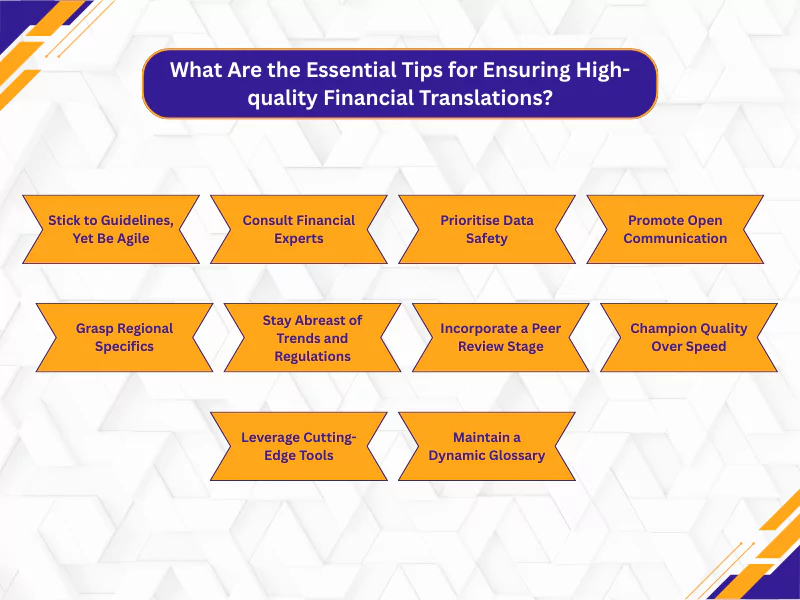
Ensuring high-quality financial translations is a multifaceted task that requires precision, expertise, and a keen understanding of both linguistic and financial nuances. Drawing on the provided sources, here are 10 financial document translation tips:
Stick to Guidelines, Yet Be Agile
While maintaining industry standards is essential, one of the best practices in financial translation is adapting your tone, terminology, and presentation style based on the specific audience reading the document, whether they are regulators, potential investors, or internal teams.
Consult Financial Experts
The ideal financial translator must possess fluency in the target language while having proper financial expertise. This specialised knowledge is essential for accurately capturing the nuance and importance of intricate financial jargon. Collaboration with economic translators, experience in financial translation services, and subject-matter experts is crucial for clarifying ambiguities and ensuring accuracy.
Prioritise Data Safety
Financial documents often contain sensitive information. Therefore, good financial translators are essential because they implement state-of-the-art encryption and other security measures to prevent data breaches.
Promote Open Communication
Promote dialogue between translators and financial experts to clarify any ambiguities and achieve the most accurate and efficient translation possible. This collaborative approach helps bridge potential gaps in understanding and interpretation.
Grasp Regional Specifics
Never underestimate the impact of local culture in financial localization. Here, numerical intricacies, formatting, currency symbols, or financial slang can significantly alter your message. Adapting to these regional specificities is crucial to avoid inaccurate financial translations and misunderstandings that could lead to costly errors.
Stay Abreast of Trends and Regulations
The financial landscape is constantly evolving, with the financial regulatory maze and practices emerging rapidly. Regularly update your knowledge and adapt translations to reflect the most recent financial guidelines and products, ensuring compliance and relevance.
Incorporate a Peer Review Stage
A second pair of eyes, especially a financial expert or subject-matter expert (SME), is invaluable. After translation, a peer review can catch errors or subtleties that might otherwise be overlooked, ensuring a “bulletproof” final product.
Champion Quality Over Speed
While prompt delivery is often necessary, sacrificing accuracy for speed can be perilous. Meticulously double-check translations for terminology consistency and precision, ensuring every number and term is spot-on, as even minor errors can have significant consequences.
Leverage Cutting-Edge Tools
Employ advanced translation tools that incorporate features like translation memory and built-in financial glossaries. These technologies can significantly enhance both the speed and accuracy of the translation process by ensuring consistency in terminology and phrasing.
Maintain a Dynamic Glossary
Financial communication and language are not static; they evolve with the industry. Regularly updating your glossary ensures that your translations remain current and resonate with contemporary audiences. Creating and adhering to a style guide and glossary helps establish consistent terminology throughout documents.
What Are the Main Challenges in Financial Translation?
Financial translation is the process that significantly depends on dealing with intricate financial regulations and expertise, while maintaining confidentiality that arises from meeting local norms and formatting requirements.
A translator’s expertise in financial and specialised terminology is essential since most financial documents include highly technical terms specific to the financial industry.
For instance, “bear market,” “hedging,” and “capital adequacy ratio” are some common financial terminologies used.
As for regulatory compliance, international financial translation must adhere to the laws and standards of each country, such as GAAP or IFRS.
Financial translation experts must maintain accuracy and consistency; for this, they essentially need to consult with experts and utilise bilingual glossaries.
While financial translations can help in market expansion, maintaining the integrity of financial materials, confidentiality, and data security is crucial, which necessitates signing a Non-Disclosure Agreement (NDA) when working with an individual translator.
The local financial cultural, and formatting differences heavily influence the process of translating financial documents; thus, translators must be flexible and adaptable.
What to Avoid in Financial Translation: Common Mistakes

Literal Translation and Ignoring Context
This mistake involves translating word-for-word without considering the nuanced meaning, idioms, or cultural context of the financial information, leading to inaccurate or misleading statements.
Over-reliance on Unedited Machine Translation
The mistake is relying on the use of translation technology as a final product without thorough human post-editing and review by a qualified financial linguist, which can lead to critical errors.
Failure to Question Ambiguities in the Source Document
Not clarifying any unclear or potentially erroneous information in the original financial document before translation can perpetuate inaccuracies. This moves beyond simply translating what’s given to proactive quality assurance.
Errors in Numerical Values, Currencies, and Date Formats
Beyond general accuracy, specific numerical errors, such as incorrect rounding, misplaced decimal points, or the use of incorrect currency symbols or date formats (e.g., DD/MM/YYYY vs. MM/DD/YYYY), can have severe financial implications.
Which Key Industries Heavily Rely on Financial Translation Services?
Banking: Translating financial statements, loan agreements, and regulatory filings.
Insurance Sector: Handling insurance policies, financial statements, and compliance documentation, understanding legalities.
Manufacturing: Translating expense reports, supply chain documents, and operational jargon.
Real Estate: Requiring translations of income statements and property listings, often involving local laws and market terms.
Corporate World: Dealing with annual reports, shareholder communications, and balance sheets for diverse stakeholders.
Tax and Accounting: Ensuring precision for invoices, tax reports, and income statements, adhering to specific tax regulations.
Investment Sector: Translating complex prospectus reports on bonds, mutual funds, and equities, where decisions are made based on these documents. In each of these industries, accurate financial translation serves as a critical backbone for international operations and partnerships.
Why Is It Recommended to Involve a Financial Expert in the Review Stage of Translations?

Accurate translations play a crucial role in the financial sector. From mitigating potential risks and maintaining regulatory compliance to matching consistency and contextual accuracy, here’s why human expertise is unmatched:
Risk Mitigation
For effective financial translations, it is essential to hire an expert with relevant financial knowledge to minimise the risks of misinterpretations and mistranslations. While translation tools can be prompt, they may fail to capture the cultural nuances of financial translations, making it essential to understand the source and target audiences, which can only be achieved by a human.
Regulatory and Industry Compliance
No financial institution or company wants to risk approval from the government or authorities; only a translator with adequate financial knowledge is well-versed in regulations and industry standards, such as GAAP, IFRS, and local tax regulations.
Consistency and Contextual Accuracy
While tools can match and be consistent with specific financial terms, an extra pair of eyes can identify minor inaccuracies and inconsistencies in financial matters, aligning with the standards of the local cultural and business environment, thereby enhancing reliability, which is essential in financial translations.
What Is the Financial Statement Translation Process: The Best Practices
Determining the Functional Currency
When it comes to financial translation process, one begins by identifying the functional currency. The functional currency is the primary currency in which a company operates and reports its transactions. This step is critical because all subsequent translation activities use this currency as the standard reference.

Translating Financial Statements
The SME or financial translator translates all financial performance statement items into the reporting currency. The income statement is translated using the exchange rate on the date each transaction occurred, and the balance sheet is translated at the rate on the balance sheet date. Methods such as the current rate method and the temporal rate method may be used, depending on the accounting standards and the company’s specific situation.

Recording Gains and Losses
Any gains or losses that arise from translating currencies at different exchange rates are recorded, usually as a cumulative translation adjustment in the equity section of the balance sheet or in comprehensive income. This step helps separate operational results from the effects of currency fluctuations.
How to Choose an Expert Financial Translation Service or Financial Translator?

Financial and Industry Expertise
Hire a translator or a professional translation service that has a vast network of translators from the industry to match professional standards and accuracy.
Data Security and Confidentiality
Always prioritise security and confidentiality; choose a service provider that offers secure file management and compliance with regulations such as GDPR or HIPAA.
Certifications and Quality Assurance
Look for ISO certification of the service, as they have a multi-layer quality assurance process for the translation.
Native Language and Localisation Skills
Hire a translator or choose a service that offers a wide range of language coverage to maintain cultural nuances.
Reputation, Transparency, and Scalability
Check for reviews, case studies, and samples on their websites and also on third-party sites for transparency.
How Much Does It Cost to Translate Financial Documents?
In Australia in 2025, the cost of translating financial documents typically varies based on the complexity of the document, its word count, certification requirements, and the urgency of the task. Certified financial translations often range from around AUD 15 to 40 per 100 words, with specialised or urgent translations costing more.
| Document Type | Typical Cost Range AUD |
| Bank Statement | ~38 AUD per page |
| Certified Translation | ~15-40 AUD per 100 words |
| Standard Financial Document | 38 to 65 AUD per page or document |
| Urgent or Specialised | Higher, variable based on requirements |
Conclusion
We hope our complete guide to financial translation tips has helped make your decision. Since financial translation plays a crucial role, always hire financial professionals to ensure accuracy and maintain the confidentiality of sensitive financial data in the globalised financial landscape. Lastly, reach out to us and share your financial translation needs to get tailored solutions at an affordable price.
Frequently Asked Questions
How Do Cultural Nuances and Local Regulations Impact Financial Translation?
Cultural nuances and local regulations profoundly impact financial translation, making a direct word-for-word translation insufficient:
- Different cultures may have distinct approaches to complex financial concepts, accounting practices, taxation systems, and even financial etiquette. Translators must possess a thorough understanding of global financial content and be mindful of these cultural differences. Furthermore, they must adapt their translations accordingly to ensure the message resonates effectively with the target audience.
- Each country has unique regulatory frameworks and reporting standards. A professional financial translator must be well-versed in the specific laws and requirements governing financial reporting in the target country to ensure compliance and avoid legal or financial repercussions. This knowledge and deep understanding of financial terminology ensure translations align with legal guidelines and local market terms.
What Role Do Technology and Specialised Tools Play in Financial Translation?
Technology and specialised tools play a significant role in enhancing the speed, accuracy, and consistency of complex financial translations. Advanced translation tools often incorporate features like translation memory (TM) tools and built-in financial glossaries. Translation memory stores previously translated segments, ensuring financial terms and phrases are consistent across different documents and projects. This also saves time and cost.
Moreover, maintaining a dynamic glossary is also crucial as financial language continues to evolve. While free machine translation tools like Google Translate are generally not suitable for financial documents due to the high risk of inaccuracies and loss of precision, professional translation agencies may utilise Machine Translation Post-Editing (MTPE), where machine output is reviewed and edited by human linguists, offering a balance of speed and quality for specific content types.
Why Maintaining Consistent Terminology is Crucial in Financial Translation?
Consistent terminology is crucial to avoid confusion and misinterpretation of the company’s financial transactions and global financial reporting. Minor variations in financial terms can lead to significant misunderstandings, potentially impacting financial decisions, legal compliance, and a company’s credibility with stakeholders.

- What Is Human Translation: Top Reasons It Beats Machine Translation - February 10, 2026
- Patent Translation: A Guide to Accurate Legal-Technical Documentation - January 29, 2026
- 60 Interesting Facts about Australia Nobody Knew - November 29, 2025