
Protecting intellectual property across the borders matters more than ever. The global economy keeps changing and the business needs to protect their innovations in multiple countries. Patent translation helps investors secure their rights worldwide. It bridges the gap between different legal system while making sure that they are compliant with the laws and technical accuracy. In this blog, you will get to know everything about these translations. Let’s begin!
Table of Contents
ToggleKey Highlights
- Patent translation needs both legal and technical skills. The translator should keep the legal meaning while explaining technical details accurately.
- Errors in patent translation can destroy patent rights. Errors leads to rejected applications and legal problems. Companies face extra cost when they have to resubmit the application.
- The Patent Cooperation Treaty helps inventors to file one application for over 150 countries. But every country requires that patent application must be filed in their official language.
- Machine translation gets only 70-85% accuracy. Patent office reject these translations. Professional translator gives 99% accuracy.
- The patent translation process follows 7 key stages to ensure accuracy.
What Is Patent Translation?
Patent translation is a special process of converting patent documents from one language to another while maintaining highly technical terms and legal validity. Unlike standard translations, it needs expertise in both legal terminology and technical subject matter, ensuring that patent applications, claims, and descriptions are accurately conveyed across languages. Just like copyright tends to protect intellectual property rights in the form of literary work, patents tend to protect inventions, processes and physical objects, etc.
Such demand needs Translation Services Australia, which understands patent law, technical concepts, and the specific requirements of different patent offices worldwide.
What Is the Importance of a Patent Translation?
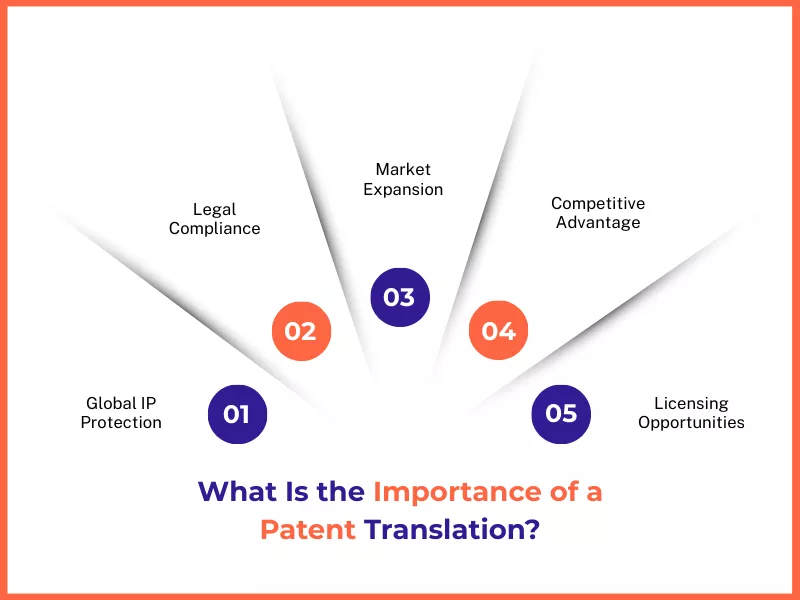
Patent translation services serve various issues:
- Global IP Protection: It secures patent rights in multiple jurisdictions.
- Legal Compliance: Translations help in meeting different patent office requirements.
- Market Expansion: Translation helps to launch the product in international markets
- Competitive Advantage: It helps in protecting innovations and maintaining confidentiality from international competitors
- Licensing Opportunities: It helps in cross-border technology transfers
What Are the Differences Between Legal and Technical Translations?
| Aspect | Legal Translation | Technical Translation | Patent Translation |
| Focus | Legal terminology and compliance | Technical specifications | The focus is on both legal and technical claims. |
| Expertise Required | Legal knowledge | Subject matter expertise | Need proficiency in legal and technical terms |
| Consequences of Errors | Legal disputes | Misunderstanding of the product | Loss of patent rights |
| Certification | Often require NAATI certified translator | Industry-specific validation | Legal certification with technical accuracy |
International Patent Filings and Compliance

Patent Cooperation Treaty (PCT)
The Patent Cooperation Treaty simplifies international patent applications. Inventors file one application that can be extended to over 150 countries. But, every country needs translation in their official language, which means if they want the translations in Portuguese or Arabic, then you must provide them in a different language.
WIPO Patent Translation
The World Intellectual Property Organisation follows the PCT system and provides guidelines for patent translations. WIPO patent translation makes sure that applications meet international standards while following the local requirements.
EPO Requirements
The European Patent Office requires translations in English, French, or German, with additional translations needed for validation in specific European countries.
What Are Consequences of Inaccurate Translations?
Errors in translated patents can result in:
- Loss of patent protection due to incorrect claims
- Rejection of patent application by patent officers
- Legal vulnerabilities in litigation
- Financial losses from resubmission cost
- Delayed market entry and competitive disadvantages
A professional patent translator must check that they are not making the mistakes which leads patent application to be rejected. They must know the difference between Translation vs Transcreation so that they incorporate the elements rightfully while translating.
Common Industries Requiring Patent Translations
Here are the industries that need to file a patent via professional translators:
- Pharmaceuticals sector, including drug formulations, medical devices, and treatment methods
- Technology sector, including software, electronics, and telecommunications
- Automotive sector, including vehicle systems and manufacturing processes
- Biotechnology sector, including genetic engineering, diagnostic tools
- Manufacturing sector, including industrial equipment, production methods
- Aerospace sector, including aircraft components, navigation systems
Types of Patent Translations

Here are the complex types of translation where the patent was translated for various uses:
Patent Application Translation
Converting initial patent applications requires that all technical specifications and claims be accurately rendered. The goal is to make sure that the patent office and localisation experts can fully understand your things.
Patent Litigation Translation
Translation of patents documents for legal proceedings, including infringement cases and validity challenges. You must prepare these well, as the accurate translation of the patent application directly affects the case outcome.
Patent Filing Translation
Preparing accurate translations specifically formatted for submission to patent offices, meeting their specific language conventions and requirements.
Informational Patent Translation
It is for understanding the contents of foreign patents. Translating existing patents for research, competitive analysis, or internal reference purposes.
Patent Validation Translation
Post-grant translations are required to validate and enforce patents in specific countries. This goes specifically in the case of European patents when it is granted, so that it is validated in each member state where you seek protection.
Patent Translation Requirements
Effective patent translation requires:
- Legal knowledge of patents in both source and target jurisdictions
- Expertise in technical terms
- Linguistic expertise
- Understanding the requirements of the patent office
- Quality assurance through multiple review stages
- Confidentiality agreements to protect proprietary information
What is Patent Translation Process?
- Initial Assessment: Review the patent required and the technical field
- Translator Assignment: Match with an accredited translator and get a free quote
- Translation: Convert text while preserving technical and legal accuracy
- Technical Review: Subject matter expert verifies terminology
- Legal Review: Patent attorney confirms claim validity
- Quality Check: Final proofreading and formatting
- Certification: Official attestation for patent office submission
What Are the Challenges in Patent Translations?
Challenges in patent translated include:
- Technical terms change across languages
- Cultural differences in patent law
- Formatting requirements differ by patent office
- Time limit from filing deadlines
Patent Translation vs. Machine Translation: Why Accuracy Matters
| Feature | Human Translation | Machine Translation |
| Accuracy | 99%+ with human expertise | 70-85% with errors in complex terms |
| Legal Validity | Certified and legally binding | Not accepted by patent offices |
| Technical Precision | Subject matter expert review | Limited contextual understanding |
| Cost | Higher initial investment | Lower cost but requires extensive editing |
| Risk | Minimal with quality assurance | High risk of claim invalidation |
Machine translation cannot replace human expertise as high stakes are involved.
What Are the Best Practices for Ensuring High-Quality Patent Translation?
- Hire specialised translators with both technical and legal credentials
- Provide reference materials, including drawings, prior art, and technical specifications
- Use glossaries to ensure consistency and fluency across documents
- Implement multiple review stages, including technical and legal reviews
- Verify compliance with target jurisdiction requirements
- Consider the back translation method for critical sections to verify accuracy
- Maintain confidentiality throughout the process
- Plan ahead to avoid rushed translations near deadlines
How to Choose the Right Patent Translation Service?
When selecting language services, consider:
- Specialised expertise in your technical field to protect the rights of the inventor
- Qualified translators with a patent law background
- Quality assurance processes, including multiple review stages, where Australian language conventions are followed.
- Strict Confidentiality protocols and non-disclosure agreements
- Track record with international patent applications to protect rights in any other foreign country
- Turnaround time that gives results, depending on the urgency
- Certification and official recognition by patent offices
How Much Does It Cost For Patent Translation?
Patent translated cost depends on many factos including language pair, document type, and deadlines. Most of the translators charge around $0.15-$0.45 per word or $25-$180 per page. The technical field matters too. Patent translations cost more than a common document, as it needs legal-technical expertise.
Cost Breakdown by Language & Region
The patent translation cost depends on the target language and region. Here’s how pricing is typically structured:
- Language pair: Some languages cost more to translate. Japanese, Korean, Mandarin cost more because there are a few translators who specialise in these linguists. European languages like Spanish, French, German cost less. For example, Spanish patent translations cost between $0.15-$0.30 per word, while Japanese translations can range from $0.25-$0.45 per word.
- Region-specific pricing: The labour costs vary by region. North American and Western European patent offices charge more than Asian markets. Good translators give competitive rates and give high-quality.
- Patent office requirements: Some countries ask for extra formatting, official certification, or sworn translations. These requirements add to the cost. OZTranslation Services provides all these services including NAATI certification and notarisation when needed. This makes the submission process easier.
Why Choose OZTranslation Services for Patent Translations?
OZTranslation Services offers comprehensive patent translation solutions with:
- Specialised patent translators combining technical expertise and legal terms knowledge, while having knowledge of applying for patents and copyrights
- NAATI-certified professionals ensuring compliance with Australian standards
- Confidentiality guarantee protecting your intellectual property
- Fast turnaround without compromising accuracy
- International expertise covering PCT, WIPO, EPO, and country-specific requirements
Conclusion
Patent translation helps in protecting intellectual property. You need professional translators who know both technical and legal detials. It just take one mistake to lose your patent rights. So, do not risk your innovation with machine translations. Choose certified experts like OZTranslation Services who deliver accurate translations that meet international patent office standards.
Frequently Asked Questions (FAQs)
How to become a patent translator?
You must have an expert level of fluency in at least 2 languages, a strong background in technology and science, and a good knowledge of legal terminology.
What is the legal requirement for patent translation in Australia?
What are the 4 types of patents?
How long will my translation take?
How will I receive my certified translations from OZTranslation services?
We will provide you with the hard copy and soft copy of your certified translation as discussed. So, you need to specify your needs and purposes so that we can help you in the best way possible.

- Overseas Grade Conversion Australia: Why Translators Can’t Convert Your Grades - September 21, 2026
- Bilingual Staff vs Professional Translators: The Risks Nobody Talks About - September 2, 2026
- How Professional Translators Maintain Accuracy Across Different Languages - August 26, 2026