
In today’s global landscape, where linguistic precision is paramount, understanding ‘what is back translation’ has never been more vital.
Table of Contents
ToggleBack translation is a vital process in the world of language services, designed to ensure the accuracy and integrity of translated content. Imagine translating a text from English to French, then having a different translator translate it back to English without seeing the original. This method helps reveal subtle shifts in meaning, cultural nuances, or potential errors that might otherwise go unnoticed.
Back translation is a powerful quality control tool, especially crucial in sensitive fields like medical, legal, or marketing communications. In this blog, we’ll explore how this technique works and why it matters, and share real-world examples demonstrating its indispensable role in bridging language gaps with precision.
What Is Back Translation: Reverse Translation Method Explained!
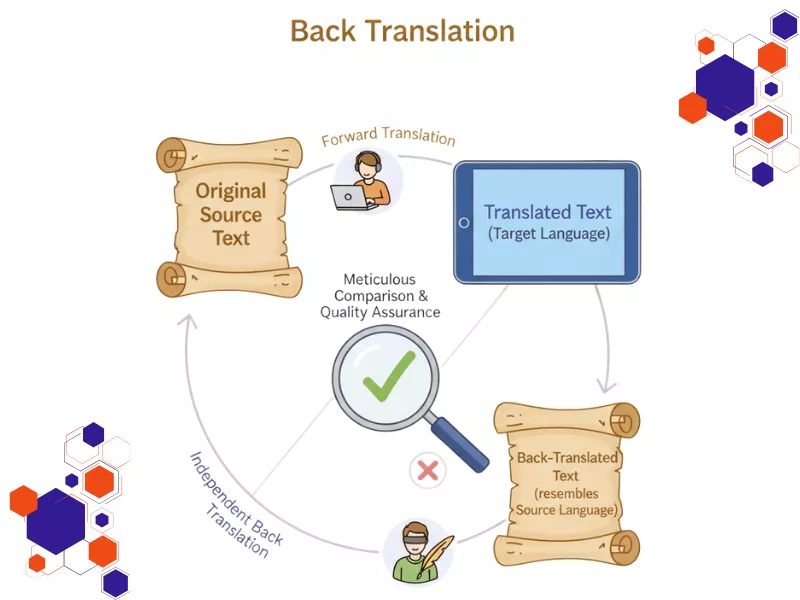
Back translation, also known as reverse translation, is a rigorous method used in translation projects to ensure original translation quality assurance by checking that the original meaning is preserved accurately throughout the translation process. It involves translating a completed translated text in the target language back to its original language by an independent translator who hasn’t seen the original source text. This new version is then compared meticulously with the original text to identify any differences in the meaning or loss of context.
Why Is the Back Translation Method Important?

The back translation method is crucial in the translation industry for several key reasons, primarily focusing on quality assurance and accuracy. By translating a document back into its original language, editors can verify that no meaning was lost during the initial process. This is a common requirement in patent translation, as it provides an additional layer of certainty that the technical terminology remains consistent and legally sound before the final version is submitted.
- Ensures the preservation of the source text’s original meaning, minimising misinterpretations and inaccuracies.
- It helps identify discrepancies and inaccuracies that might have crept into the translation process, ensuring that the meaning of the translation remains true to the original.
- Back translation helps verify that cultural nuances and contextual relevance are accurately conveyed, especially in highly sensitive medical, legal, or technical fields.
- This method is essential for detecting issues, allowing revisions before final publication or use.
- This method allows clients and translators to have a clear audit trail, promoting transparency and accountability in the translation process.
- Back translation improves translation quality by highlighting errors or gaps that might go unnoticed, thus saving time and costs associated with post-publication corrections.
- It supports compliance in regulated industries, ensuring that translated content accurately reflects the original text in a target language while adhering to regulatory standards.
Overall, back translation plays a crucial role in safeguarding translation quality, especially in fields where accuracy and cultural relevance are vital to success and reputation.
What Are the Benefits of Back Translation?
Here are the benefits of English back translation:
- Ensures the translated content faithfully represents the original text’s meaning, improving overall accuracy.
- Identifies cultural misunderstandings or potential misinterpretations that might affect the target audience.
- Maintains consistent terminology and phrasing across different translations, enhancing clarity and uniformity.
- Provides clients with confidence that their message is accurately conveyed in the target language.
- Acts as a robust quality control method by allowing a detailed comparison between the original text and the back-translated version.
- Helps detect errors, ambiguities, or omissions in technical, legal, or medical translations where precision is critical.
- Supports regulatory compliance in industries requiring certified and precise translations, such as healthcare and pharmaceuticals.
- Reduces risks and costly errors by catching issues before publication or distribution.
- Enhances communication by ensuring that localised content remains contextually relevant and culturally appropriate.
- Offers a clear audit trail for transparency in the translation process, which builds trust between translators and clients.
Overall, back translation significantly improves translation quality, reduces errors, and ensures your message resonates accurately and reliably across languages and cultures.
What Is the Back Translation Process?

The back translation process involves several defined steps to ensure translation accuracy and quality:
- A professional translator first translates the original text into the target language.
- A separate independent translator then translates this completed translation back into the source language without referring to the original text.
- The back-translated version is compared with the original text to identify meaning, tone, or nuance differences.
- Discrepancies or changes are discussed, corrected, and refined to improve the translation quality for various types of translation.
- This iterative process continues until the final translation accurately represents the source language content.
When Should You Use Back Translation Projects?

- Accuracy is critical when working with sensitive documents like medical, legal, or regulatory texts.
- During clinical research involving surveys or questionnaires, precise cross-cultural adaptation is needed.
- To ensure high-quality localisation of marketing materials that require cultural and contextual fidelity.
- When verifying translations for compliance with international and industry standards.
- Whenever there is a need for translation quality assurance in critical communications or publications, it is important to ensure accuracy.
When Not to Use Reverse Translation?
Reverse or back translation may not be suitable for all content for back translation. It is generally avoided when dealing with marketing or creative materials, where flexibility and emotional tone matter more than literal accuracy. In these cases, back translation may distort the creative intent or intended meaning due to emphasis on linguistic equivalence over style. Additionally, machine translation and automated tools are not recommended for back translation, as they lack the ability to recognise cultural nuance and perform effective quality assurance.
5 Back Translation Examples: How Back Translators Maintain Quality and Accuracy
Medical Device Translation:

Back translation is used to verify instructions and warnings on devices like glucometers, blood pressure monitors, and pacemakers. This ensures critical information about usage and safety is accurately conveyed to users and healthcare practitioners, preventing potentially life-threatening misunderstandings.
Clinical Research and Pharmaceutical Trials:

In clinical trials, documents such as consent forms, drug labels, and patient information leaflets undergo back translation. This practice helps ensure that all participants fully understand the risks and protocols, minimising ethical and legal risks.
Legal Contracts and Regulations:

Back translation aids in preserving the exact legal intent of contracts, taxation laws, customs documentation, and insurance policies for multinational companies to ensure clarity and compliance across jurisdictions.
International Marketing Campaigns:

To ensure slogans, promotional messages, and brand names resonate properly in different cultures without offending or losing meaning, marketing materials are back translated. For instance, global brands often use this method to preserve brand integrity and effectiveness.
Multilingual Surveys and Educational Tests:

Back translation verifies that survey questions or educational test items maintain their meaning and cultural relevance when adapted for different languages, ensuring data accuracy and fair assessments. This step is especially critical in CALD community research, where survey instruments must stay conceptually equivalent across every language version for the findings to be valid.
These examples demonstrate the vital role back translation plays in regulated, technical, legal, marketing, and research fields to maintain the integrity of critical information and communications across languages.
5-Step Back Translation Readiness Checklist
A back translation is a quality control (QC) measure where an independent linguist translates a translated document (Target Text) back into the original language (Source Language). This checklist ensures all preconditions are met before commencing the back translation phase, maximising efficiency and value.
Step 1: Finalise and Vet the Forward Translation
Ensure the back-translated translation (the Target Text) is the final, approved version and is ready for the QC check.
| Status | Checkpoint | Detail |
|---|---|---|
| Forward Translation Finalised | The forward translation (Target Text) has been completed, reviewed, and approved by the original linguist team and project manager. No further edits are anticipated before the back-translation phase begins. | |
| Target Text is Clear and Editable | The target text is provided in a standard, editable format (e.g., DOCX, clean text) and is free from layout or formatting errors that could confuse the back translator. | |
| Source Text is Attached | The original Source Text is included in the project package to provide context and ensure alignment on terminology, even though the back translator focuses primarily on the Target Text. |
Step 2: Define the Back Translation Mandate
Clarify the specific goal of the back translation, as this dictates the translation style (literal vs. conceptual).
| Status | Checkpoint | Detail |
|---|---|---|
| Purpose is Clear | The project goal is defined (e.g., clinical validation, regulatory submission, internal review). | |
| Style Mandate is Set | The back translator is explicitly instructed whether to be Literal (word-for-word, common for regulatory materials) or Conceptual/Meaning-based (focus on conveying the exact intent, common for marketing). | |
| Annotated Output Requirement | Determine if the back translator needs to provide specific annotations or comments on potential ambiguities or cultural differences encountered in the Target Text. |
Step 3: Assemble and Share All Reference Materials
The back translator, while independent, must have access to the same foundational terminology and style rules used for the original forward translation.
| Status | Checkpoint | Detail |
|---|---|---|
| Glossary/Terminology Provided | The final, approved glossary or list of key project-specific terms (if used for the forward translation) is shared with the back translator. | |
| Style Guide Included | Any relevant style guide, brand guide, or specific formatting instructions are provided. | |
| Contextual Documentation Shared | All relevant background documents or surrounding materials necessary to understand the document's context are included. |
Step 4: Select and Onboard the Independent Linguist
The back translator must be a neutral, qualified third party to ensure an unbiased quality check.
| Status | Checkpoint | Detail |
|---|---|---|
| Translator Independence Confirmed | The back translator has no prior involvement in the original translation or review of the Target Text. | |
| Native Speaker Verified | The back translator is a native speaker of the Source Language (the language they are translating into). | |
| Briefing Completed | AllThe linguist has been formally briefed on the style mandate (Step 2) and the purpose of the back translation, and has confirmed receipt of all project files and reference materials (Step 3). |
Step 5: Establish the Reconciliation and Review Protocol
The back translation is only valuable if a systematic review (Reconciliation) is performed to identify and resolve discrepancies between the original source and the final back translation.
| Status | Checkpoint | Detail |
|---|---|---|
| Reconciliation Team Assigned | The team responsible for reviewing the back translation against the original Source Text and suggesting changes to the Target Text is clearly identified (usually the Project Manager and/or a Subject Matter Expert). | |
| Discrepancy Severity Defined | Clear guidelines exist for classifying discrepancies (e.g., minor, cosmetic, critical) and determining which changes must be applied to the Target Text. | |
| Final Approval Pathway Set | The process for sign-off on the reconciled and final Target Text (after all corrections based on the back translation are applied) is documented and agreed upon. |
Find Back Translators to Avoid Common Mistakes

Infographics
Ensuring precision in translation requires more than linguistic knowledge—it demands a structured process designed to maintain the original meaning, tone, and cultural relevance throughout the entire translation task. Here’s how professional translation agencies prevent common back translation errors while enhancing quality and consistency.
Word-for-Word Translation Issues
Literal translation is one of the most frequent issues in standard translation and back translation. Translating word-for-word instead of for meaning can distort the exact meaning of sentences and diminish fluency. When back translation involves idioms, tone, or metaphor, it’s crucial to interpret the idea, not just the words. This quality control method helps ensure that the translation back to its source language fully conveys the intended message and context.
Ignoring Cultural Context
Effective translation management requires sensitivity to idioms, humour, and local norms. Professionals ensure that the translation maintains cultural balance to align the meaning between the source and target texts. Back translation helps reveal when culturally dependent phrases were misunderstood or simplified, ensuring the text and the back-translated version communicate appropriately across markets. Cultural context is crucial for Australian marketing localisation.
Overreliance on Machine Translation
While AI tools can assist routine tasks, overusing them can compromise accuracy. Back translation provides a human verification layer by having an independent translator translate it back into the source language. This approach is part of the broader translation quality assurance strategy, ensuring that translations are not only grammatically correct but also accurately reflect the original translation’s sense and purpose.
Lack of Subject Expertise
Translators must understand technical terminology and its context when working on specialised texts—such as medical or legal documents. A successful back translation process includes domain experts who can identify differences in the meaning or terms. This ensures that the translation comes from a place of informed understanding and that the text and the back translation fully align with professional standards. Community checking in translation is equally important, and businesses expanding to new markets use it to make their message culturally appropriate.
Skipping Proofreading and Review
One of the most damaging oversights is skipping the comparison and review steps. The process of back translation serves as a quality assurance method, comparing the text and the back-translated version with the original text. This confirms that the translation was accurate, and the return to its original language version preserves tone, clarity, and exact meaning. It is part of any thorough translation management system that prioritises quality assurance from start to finish.
Why Back Translation by a Professional Translator Is Critical?
A professional translator’s back translation is necessary when absolute precision is essential, such as in healthcare, legal, or governmental documents. They ensure that any issues in the translation are spotted before publication. Furthermore, hiring a back translator to your workflow can improve translation reliability and give you the confidence that every nuance and intention of the source text has been carefully verified back into the source language. This is especially effective for public-sector files, where the mistakes to avoid in government translation tend to be terminology errors a generalist would never spot.
Need Back Translation Services for Your Next Translation Project? Contact Us!

Looking for reliable Translation Services in Australia that deliver precision and confidence? Our professional translators specialise in back translation—a rigorous quality assurance step designed to guarantee that your translated content retains every nuance of meaning and tone from one language to another.
With our comprehensive back translation checklist, your document goes through a double verification process. Every accurate translation is reviewed by a second linguist who retranslates the text back to the original language, ensuring that no cultural subtleties, technical terms, or critical context are lost in the process. This extra layer of quality control enhances compliance and consistency across industries such as healthcare, legal, research, and corporate communication.
Whether you are preparing regulatory materials, translating clinical research documents, or creating multilingual marketing campaigns, our team ensures seamless cross-cultural communication while maintaining precision and professionalism.
Need dependable results that speak accurately in one language and back to the original language? Choose our certified experts for unmatched translation clarity, consistency, and credibility.
Contact us today to safeguard your next translation project with Australia’s most trusted back translation specialists.
Frequently Asked Questions
Who Uses Back Translation?
Back translation applications are common in fields that require precise, high-stakes communication. Organisations in clinical research, pharmaceuticals, and medical device manufacturing frequently require back translation to validate that translated content matches the intended meaning of the source text, ensuring regulatory compliance and patient safety. It is also used in market research and legal and technical documentation to maintain translation quality and confirm that the translation helps convey meaning accurately across cultures.
What Is a Backward Translation?
A backward translation, also known as a double translation or reverse translation, involves translating a completed translation in the target language back to the original language by a different translator who hasn’t seen the source text. This method cross-checks the translation quality by comparing the back to the original language version against the original text to identify any differences in nuance, accuracy, or function. This step is a part of the back translation workflow and serves as a key item in a back translation checklist.
Who is the father of machine translation?
Warren Weaver is widely considered the “father of machine translation.” His 1949 memorandum, “Translation,” laid the foundational ideas for the field, proposing that code-breaking techniques from World War II could be applied to language translation.
What Is the Purpose of Back Translation?
The main purpose of back translation is quality assurance, ensuring that the initial translation retains the original document’s meaning, function, and tone. During the back translation workflow, linguists compare the original text and the final translation to verify that the translation accurately conveys the intended meaning and that no key information was lost or altered. This is particularly critical in contexts like clinical research and legal contracts, where even slight deviations from the source language could lead to miscommunication or compliance issues.
How to Handle Character Limits in Back Translation?
Managing character limits in back translation requires balancing translation accuracy with technical constraints. Translators follow best practices for back translation by ensuring that the source text and target language versions remain consistent while respecting design or UI restrictions such as app interfaces, email subject lines, or advertisements. Using translation memory systems can streamline this process, allowing teams to track changes, preserve tone, and optimise the final translation without exceeding set limits. In such scenarios, back translation ensures that the new translation still accurately conveys the meaning of the original language message.

- Overseas Grade Conversion Australia: Why Translators Can’t Convert Your Grades - September 21, 2026
- Bilingual Staff vs Professional Translators: The Risks Nobody Talks About - September 2, 2026
- How Professional Translators Maintain Accuracy Across Different Languages - August 26, 2026