


What if you wake up in a different part of the world where no one speaks English? Forget asking for a coffee; you’ll struggle to build that connection with the first greeting of the day, ‘good morning.’ Even though everyone around the world understands the ‘good morning’ greeting, using their native language helps create an instant connection.
Table of Contents
ToggleAustralia is one of the countries that is known for its cultural diversity. Therefore, knowing how to say good morning in different languages becomes even more important. It sets the tone of the day and helps build connection and goodwill.
On that note, let’s take you through a brief history of the most popular greeting before delving deep into the morning rituals across different cultures.
The Curious Case of ‘Good Morning’: A Whisper from the Past
Good morning, as we all use it today, has evolved. The greeting that seems casual and marks the start of the day was not the same from the beginning.
The greeting, ‘good morning’ as we know it today, evolved from the archaic word ‘good morrow’ used in Middle English in the 14th century. The term ‘morrow’ came from the Old English word ‘morgen’, meaning the next day or morning, which was rooted in the Proto-Germanic ‘murgun.’ Good morning became popular in the 15th century when ‘good morrow’ started fading away.
The shift retained the connection to the dawn of a new day and added a meaning that marked a time when people began focusing on new beginnings.
That should set the stage for how important a simple greeting is to all. In the following few sections, we will delve deep into the mornings of different cultures and help you learn how you should greet when you are out of town.
The ‘Good Morning’ Global Passport: Key Greetings and Their Cultural Echoes
Now that we understand the origins and background of the greeting, let’s look into a few ways to say good morning in different languages:
A. Japanese:Ohayo gozaimasu
In Japan, if you are greeting someone before 10:00 am, ‘ohayo gozaimasu’ is the right choice. The term ‘ohayo’ means early and reflects a cultural appreciation of promptness and getting a good, early start to the day.
The greeting is accompanied by a bow, which reflects the mutual respect and relationship between speakers. Also, it is interesting to note that this greeting can sometimes be used in the afternoon or evening if you are meeting someone for the first time.
B. Arabic:Sabah al-khayr
The greeting ‘sabah al-khayr’ translates to ‘morning of goodness’ or ‘good morning’. Unlike English, Arabs reply to sabah al-khayr with ‘sabah an-noor’, which means ‘morning of light’. This exchange goes beyond the simple greeting and turns it into a wish for goodness and illumination.
The greeting is universal across all regions. However, the different regional dialects, similar to different language conventions in English, can have minor pronunciation differences for good morning in Arabic.
C. Korean:Jal-jat-ssuh-yo?
Koreans have a very nice way of greeting. Instead of saying good morning, they say ‘jal-jat-ssuh-yo?’ which translates to ‘did you sleep well?’While the casual way of greeting someone at the start of the day in Korea is ‘joh-eun achim’, ‘jal-jat-ssuh-yo’ is more commonly used by Koreans.
The Koreans use this to make the greeting more polite, which helps build connections.
D. Navajo:Ya at eeh abini
The Navajo are native American people from the Southwestern United States. The phrase means good morning. To break it down, ‘ya at eeh’ translates to ‘good’ and ‘abini’ means ‘morning.’ The greeting reflects a deep connection to the natural world. Furthermore, it serves as a wish for goodness and harmony from the outset of the day.
The language is one of the indigenous languages and must be preserved for its emphasis on culture through these greetings. UNESCO’s Indigenous Languages Decade is aimed at protecting these languages.
E. Irish Gaelic:Dia duit ar maidin
Another language that adds more meaning to the morning greeting, the Irish Gaelic greeting translates to ‘God be with you in the morning.’ The greeting sheds light on the influence of religion in Irish culture and daily life.
Dia duit (God be with you) is a general greeting in Ireland and can be used at any time of the day. Ar maidin (in the morning) is used in the morning for specificity.
F. Swahili:Habari za asubuhi
The literal translation for this greeting is ‘How is the news of the morning?’ or ‘What’s the news of the morning?’ As you can see, the greeting is not a statement; it is a question. It acts as a great way to start a conversation.
The general response to this question can be either Nzuri (good) or Nzuri sana (very good). It helps build a sense of community by talking about each other’s well-being and sharing their start of the day.
While English is considered the official language of Australia , there are many more languages spoken in the country. Now, the question is, why should you learn how to greet good morning in different languages? Let’s answer that in the following section.
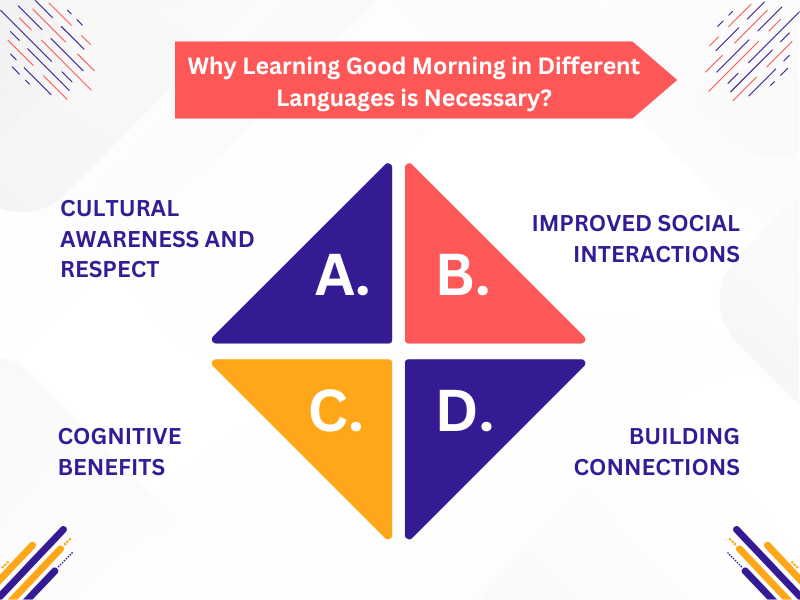
Why Learning Good Morning in Different Languages is Necessary?
Nothing you learn will go in vain. Furthermore, as more people travel to different countries for work or education, learning a new language will only add to the benefits. The first step to learning a new language is understanding how people in different regions greet each other.
There are various ways to say “good morning” based on where you are going. Let’s take you through the major reasons you must learn to say “good morning in different languages:”
A. Cultural Awareness and Respect
Learning good morning greetings in different languages can help you demonstrate an appreciation for different cultures and break communication barriers. Furthermore, it reflects your effort in making a connection with someone in their language.
B. Improved Social Interactions
Your language skills can help improve social interactions when you are in a foreign country. It can help make the people of different regions feel acknowledged and valued.
C. Cognitive Benefits
Believe it or not, learning languages can help you improve your problem-solving skills, memory, and concentration. A simple knowledge of saying good morning in many languages can help you improve these skills.
D. Building Connections
Learning to say “good morning” in different languages can help you connect with people who do not speak the same language. You can use it while travelling, working in a multicultural organisation, or to make new friends. Once you’ve mastered a basic greeting, another essential phrase for any traveller is learning how to show gratitude. For example, if you’re planning a trip to Southeast Asia, a great place to start is learning how to say thank you in Thai.
Those are strong reasons to learn a new language. However, considering that there are 6000 languages in the world, it is impossible to learn how to greet others in all these languages. To keep things under control, we have listed a few languages in the next section that are popular and you must learn.
An Expanded List of Morning Greetings

- French – Bonjour
- Spanish – Buenos dias
- German – Guten Morgen
- Italian – Buon giorno
- Mandarin Chinese – Zǎo shang hǎo
- Hindi – Suprabhat
- Russian – Dobroye utro
- Portuguese – Bom dia
- Greek – Kaliméra
- Dutch – Goedemorgen
- Turkish – Günaydın
- Vietnamese – Chào buổi sáng
- Thai – Sà-wàt-dee tawn cháo
- Indonesian – Selamat pagi
- Swedish – God morgon
- Polish – Dzień dobry
- Finnish – Hyvää huomenta
- Hungarian – Jó reggelt
- Czech – Dobré ráno
- Danish – Godmorgen
- Cantonese – Jóu-sahn
When Should You Learn to Say Good Morning in Different Languages?
Numerous people are not aware of when to learn to say good morning in a different language. Let’s take you through them:
A. Travel
If you are travelling to a country where the native speakers greet in a different language from the one you speak, you must learn the language to make a good first impression.
B. Interacting with Diverse Communities
In case you are working in a multicultural environment like that in companies offering translation services and interacting with diverse communities, learning their language will help you build rapport and show respect for their culture.
C. Personal Enrichment
Do it for your personal experience. Learning a few more ways to say good morning beyond the one you know can help you expand your linguistic skills.
D. Abroad Education
Students moving to a foreign country for higher education can benefit from learning the different ways to greet people. This helps build an instant connection with your peers and have a great educational experience abroad.
Beyond ‘Good Morning’: The Universal Language of Connection
The greeting ‘good morning’ is not only about wishing someone a good day, but it is also about making the effort. When you take the step and speak in a language that the other person from a different culture does, it makes a simple greeting all the more special.
If you delve deep, this is not just a greeting, but a bridge that connects different cultures. The history of ‘good morning’ makes this all the more special. So, take the first step and learn how to greet someone in a different language to build that instant connection and bridge the gap between cultures.
Happy learning!

- What Is Human Translation: Top Reasons It Beats Machine Translation - February 10, 2026
- Patent Translation: A Guide to Accurate Legal-Technical Documentation - January 29, 2026
- 60 Interesting Facts about Australia Nobody Knew - November 29, 2025