


The key difference between translation and transcreation is:
Table of Contents
Toggle- Translation conveys the literal meaning of text across languages, focusing on accuracy for documents.
- Transcreation creatively rewrites the content to evoke the same emotion and cultural impact as the original. It blends translation and copywriting to connect with a new audience.
That’s the simplest way to understand the difference between translation and transcreation. However, when it comes to choosing the right one, people often get confused. Here, we will explore translation vs transcreation in detail and take you through the meanings of each, followed by key differences and a few other important facts to ensure you understand the concepts well.
Let’s get started!
What Is Translation?

Simply put, translation is the process of converting content from one language (source language) to another (target language) without hampering the original meaning and intended message. Translation aims to convey a message, cultural nuances, and ideas accurately and clearly in the target language.
Translation is a crucial part of the migration process, where individuals migrating to a different country need to translate their documents for visa applications. They often look for ‘translation services near me’ to hire a professional for accurate results.
What Is Transcreation?
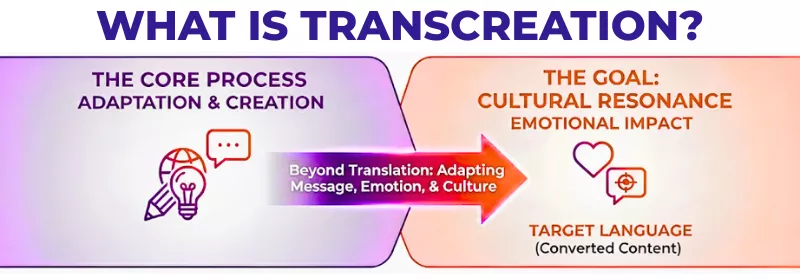
Transcreation goes beyond simple translations. The process, a part of language services, can be defined as one that does not translate a message from one language to another, but also ensures that it adapts to the cultural nuances and emotional context of the target audience, more like that amalgamation of translation and creation.
Transcreation aims to ensure that the message resonates with the target audience without compromising the emotional impact, intent, and engagement of the original message. It is one of the specialised and creative types of translation.
The process finds importance in marketing and advertising materials, like slogans, taglines, product names, and any content that aims to connect with an audience emotionally. Companies use transcreation services to ensure that their message is conveyed properly to their target audience.
Translation vs Transcreation: Key Differences
By now, you have an idea about transcreation and translation and a somewhat vague understanding of how they are different from one another. However, there are more differences between transcreation and translation than what you have learned till now. So, without further ado, let’s address the elephant in the room and learn about the key differences:
| Aspect | Translation | Transcreation |
| Core Objective | Accurate, word-for-word, or meaning-for-meaning conveyance of source text | Recreates emotional impact, intent, and audience engagement, often rewriting for resonance |
| Relation to Source | High, stays close to the original wording and structure | Low, prioritises the target audience response over literal match |
| Creativity Level | Limited, relies on linguistic precision | High, involves copywriting, adaptation, and reinvention |
| Cultural Adaptation | Minimal, focuses on language equivalence | Extensive, tailors idioms, humour, tone to local culture |
| Process | Direct conversion by translators | Collaborative writing by transcreators |
| Output Style | Preserves original length, format, and style | May change length, structure, visuals, or elements for effect |
| Ideal Use Cases | Technical docs, legal contracts, and manuals | Ads, slogans, marketing, branding campaigns |
| Required Skillset | Language expertise and terminology knowledge | Cultural insight, creativity, marketing savvy |
| Cost and Time | Generally lower and faster | Higher due to iteration and creativity |
That will give you an idea about how translation is different from transcreation. Further, you will be able to understand what to choose, translation or transcreation, for your project.
An Insight into the Cost and Process of Transcreation
Before we talk about other things, let’s give you an idea about the cost and process of transcreation.
The Cost of Transcreation
Transcreation is costly when compared to translation, as mentioned earlier. The reason is that the cost of translation depends on factors like word count or page count, while transcreation needs additional creative effort and expertise.
Transcreation cost can vary depending on the level of creative adaptation, content complexity, and project-specific requirements.
The Transcreation Process
While translators work to find the right words in the target language, prioritising linguistic and grammatical aspects, transcreators are more like creative writers than literal translators. If you are wondering what is human translation‘s role here, it serves as the foundational step. It provides the literal framework that a transcreator then evolves to align with the target audience’s emotional triggers. They rework the text to ensure it aligns well with the cultural preferences, values, and emotional triggers. Transcreators work on the core message and evolve it into a form to align with the target audience.
While that clears all the confusion, one remains: ‘Is transcreation similar to localization?’ Let’s answer the question in the following section.
Is Transcreation Similar to Localisation?
No. While localisation and transcreation share the same goal of cultural adaptation, the scope and creativity are different. Localisation adapts content for functional usability in a target market, while transcreation recreates messaging for emotional impact.
The difference lies in their scope. While localisation deals with different elements like text, formats, visuals, and technical adjustments, transcreation deals with creative briefs like ads, slogans, etc.
Additionally, creativity is high in transcreation compared to localisation. Further, the relation to the source for localisation is high when compared to transcreation. All these clearly show how both are different from one another.
Despite sharing the same goals, transcreation is not similar to localisation just as Translator vs interpreter. So, do not confuse one with the other.
Moving on, we will now focus on when you will need to opt for transcreation.
When Do You Need to Opt for Transcreation?
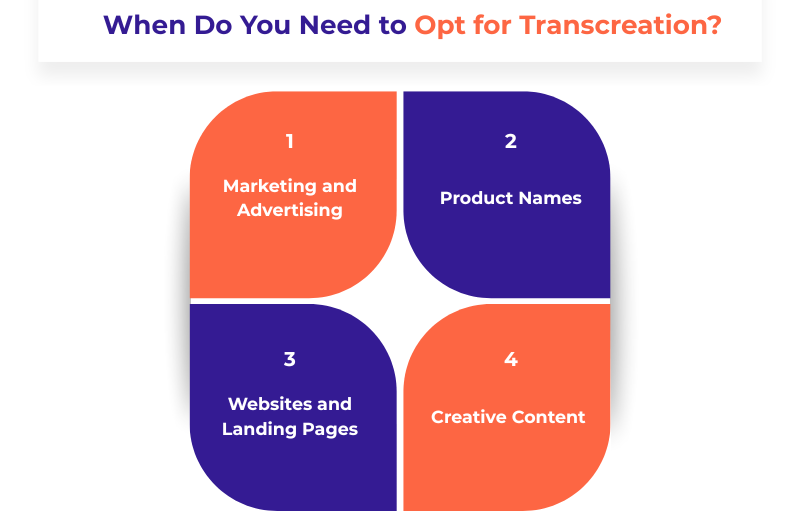
Creative translation or transcreation is mainly used by businesses to convey their messages to the local audience. Transcreation is ideal for marketing where the emotional impact is more important than a literal word-for-word match. However, technical filing requires the opposite approach, strict accuracy. This is especially true for international patent applications, where even a minor creative deviation in terminology could narrow the scope of legal protection or lead to a rejection by foreign patent offices.
A. Marketing and Advertising
Transcreation is mainly used for reaching multilingual audiences. In marketing and advertising, slogans rely on wordplay, cultural reference, or humour that might not be translated directly into another language. The transcreation process helps in engaging audiences through promotional materials, slogans, taglines, brand messaging, and creative campaigns.
Here’s an example to help you understand better:
Pepsi ‘Come Alive with Pepsi’ in Mandarin: The literal translation meant ancestor resurrection in Mandarin. It was transcreated to ‘Pepsi Brings You Back to Life’ to convey how it helps people refresh, thus avoiding any cultural taboo.
B. Product Names
This is also a part of marketing transcreation. The process helps in ensuring that the name does not convey any unintended negative connotations in the target market. In many cases, brands also rely on what is transliteration—writing a word from one language in another script while preserving its pronunciation—to maintain brand identity across languages.
Below is an example to help in better understanding:
Coca-Cola in China – Coca-Cola was transcreated to Kekoukele, meaning tasty and fun, to recreate refreshment joy, avoiding the literal coca leaf issues.
C. Websites and Landing Pages
The varying values, norms, and communication styles in different cultures make it important for businesses to transcreate their websites and landing pages. The transcreation process helps align the website with the cultural preferences and sensibilities of the new market.
The following is an example of transcreation used in websites and landing pages:
IKEA Product Pages – The Swedish company transcreated their product pages to fit into the Middle East audience to recreate an aspirational lifestyle copy respecting modesty norms.
D. Creative Content
Content that depends on creativity, wordplay, or artistic expression needs transcreation to keep the artistic integrity and impact intact.
Here’s an example:
Swiffer Rhyme – The rhyme was transcreated to ‘Quando Swiffer pulisce, il tuo mondo sorride’, which means ‘when Swiffer cleans, your world smiles’ in Italy. It captured joy beyond cleaning efficacy.
When Do You Need to Opt for Translation?
You must opt for translation when you need literal accuracy and a close relation to the source text. This is important when the information is more important than emotional or creative adaptation. The approach is more suited for content where no deviation can occur.
Translation plays a crucial role in legal contracts, medical reports, technical manuals, academic papers, and patents to ensure consistency across both original and translated documents. Individuals can also use it for e-learning modules, user guides, or regulatory documents where structure and facts must remain unchanged.
That will give you a clear idea of which one to choose: translation or transcreation. It is highly recommended that you avail of translation and transcreation services to ensure the accuracy of results.
How Do Transcreation and Translation Overlap?

Transcreation and translation overlap in the foundational aspects and the common aim of cross-language communication. Both process starts with understanding the source text. Also, professionals need bilingual proficiency, cultural awareness, and writing skills in the target language to perform both.
Translation and transcreation need an accurate understanding of the original intent and often use tools like translation memory or back translation for validation. Here’s a quick overview of where both of them overlap with each other:
- Linguistic base – Both convert concepts across languages
- Cultural insight – Essential for nuance in both
- Professional skills – Native-level writing and research
- Workflow tools – Translation management systems help both
Before we draw the curtain, let’s take you through one last section about whether all translators can transcreate or not.
Can All Translators Transcreate?
This is a question that needs to be answered before bringing an end to the discussion. To answer it in one line: no, all translators cannot transcreate. The fact that transcreation needs specialised creative, marketing, and copywriting skills beyond standard linguistic accuracy makes it difficult for most translators.
Translators are well-versed in precise word-for-word meaning conversion, research, and terminology, but do not have the creativity, cultural reinvention, and audience persuasion. Transcreators are more like native copywriters, rewriting for emotional impact, which demands separate training in projects, multimedia, and industry collaboration.
A transcreator is expected to be a language professional working towards their mother tongue. It is expected that the professional lives in the same country as their target audience.
Further, transcreation needs to be done by a translator or copywriter who has the necessary creative skills and have gone through a creative writing training.
Various sources look at transcreation as an advanced service needing dedicated modules, not assumed in basic translator certification like NAATI’s focus on complex text patterns.
To End with,
The definitions of translation and transcreation clearly suggest how they are different from one another. Further, you now understand what translation projects are and how effective transcreation can help brands make their voice heard to their target audience.
Undeniably, transcreation is expensive than translation, but the impact is equally high. Adding on, the transcreation examples clearly state how brands from across the world have benefited from it.
Make the right choice and avail of professional services for both translation and transcreation to get accurate results. A word of advice: Do not rely on machine translations when it comes to official documents; hire a professional translator instead.
Frequently Asked Questions (FAQs)
How does a translation management system support transcreation projects?
Translation management systems can streamline transcreation workflows by integrating translation memory for consistent terminology in traditional translation phases. They also allow back translation reviews to check the goal of transcreation, recreating emotional resonance, boosting engagement, and conversion rates.
What role does back translation play in effective transcreation?
Back translation reverses transcreated content to the source language to ensure alignment with the original intent beyond word translation accuracy. Unlike standard translation, back translation in transcreation highlights creative adaptations, making it essential for professional translation.
When does transcreation require human translation over machine tools?
Transcreation requires human translation in all scenarios. Machines lack the understanding of cultural contexts, thus making effective translation in persuasive contexts almost impossible.
What are the three types of translation?
The three primary types of translation are:
- Certified translation
- Notarized translation
- Industry-specific translation
How do translation and localisation complement transcreation?
Translation and localisation provide the foundation, accurate text conversion, and functional tweaks, while transcreation adds the emotional layers for creative content. The full workflow starts with translation approach for facts, layer localisation for usability, and then applies transcreation to ensure marketing materials resonate with the target audience.
What metrics measure successful transcreation in action?
Track engagement and conversion rates, A/B testing of transcreated vs standard translation versions, and brand recall surveys to quantify the importance of transcreation. Tools like translation memory help in understanding the traditional translation performance and understand when transcreation is required in global campaigns.

- Tagalog vs Filipino 2026: What’s the Difference? - January 14, 2026
- 8 Tips to Consider Before Hiring a Translation Agency [Best Translation Companies] - December 27, 2025
- Translation vs Transcreation: Which One to Choose? - December 19, 2025