
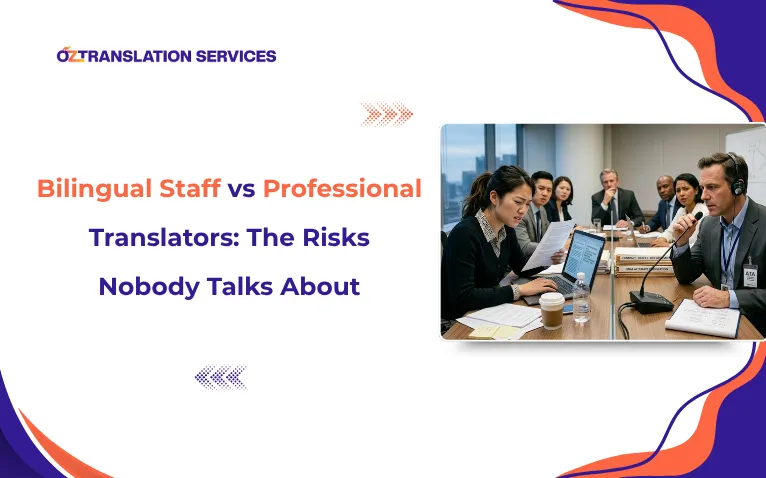
Allowing your bilingual receptionist to translate a legal contract may seem like a cost-effective decision. However, in reality, such a decision can lead to serious consequences that no internal policy can fix. When comparing bilingual staff vs professional translators, the difference isn’t just a certificate; it is the difference between a successful deal and a costly lawsuit. If you are thinking of using employees to translate documents to save a few dollars, read this article first! We are sure that your outlook will be completely changed in the end.
Table of Contents
ToggleKey Takeaways on Bilingual Staff vs Professional Translators
- Being bilingual is a communication skill, but professional translation is a technical discipline requiring specific training in meaning transfer.
- Australian authorities generally reject translations for official or legal purposes unless they are completed by a NAATI-certified practitioner.
- Using untrained staff leads to “false friends” and mistranslations that can result in significant financial and legal exposure.
- Professional translators help organisations meet regulatory requirements by using specialised terminology that bilingual employees typically do not command.
- Tasking staff with translation creates operational bottlenecks and risks brand damage through accidental cultural insensitivity or linguistic errors.
Is Being Bilingual Enough to be a Translator?
No, being bilingual is not enough to be a professional translator. Translation requires specialised writing skills, cultural awareness, technical expertise, and sometimes industry-specific knowledge and compliance with legal standards beyond just knowing two or more languages.
In countries like Australia, translating documents for official and legal purposes even requires specialised certification (discussed in the later section) that a regular bilingual person often doesn’t hold.
What's the Actual Difference Between Someone Who Speaks a Language and a Professional Translator?

The core difference between a bilingual speaker and a professional translator is language fluency vs translation competency.
Language fluency is the ability to easily speak, read, and understand a language for interactive communication. Translation competency, however, is a deliberate, trained skill set that requires textual analysis, technical writing mastery, and the ability to transfer meaning across languages without losing intent, tone, or context.
| Differentiating Factors | Bilingual Speaker | Professional Translator |
| Primary Skills |
|
|
| Training/Certification | Generally, no. | Yes (e.g., in Australia, NAATI-certified translators). |
| Cognitive Process and Methodology |
|
|
| Cultural Insight | Awareness of surface-level idioms and social slang. | Complete decoding of historical context, cultural nuances, and functional equivalent terms and idioms. |
| Technical Accuracy and Terminology | Relies on broad, general vocabulary for everyday life; often leads to literal, awkward phrasing. | Uses specialised glossaries of approved sector-specific terms to ensure exact industry terminology. |
| Professional Tools |
|
|
| Accountability | None. | Bound by strict quality standards, confidentiality, and legal liability. For example, in Australia, complying with the AUSIT code of ethics. |
What Is the Difference Between a Bilingual Employee and a NAATI Certified Translator?
A bilingual employee speaks two or more languages for standard communication and understanding. Their language skills are casual, self-taught, or acquired through multicultural interactions. They rarely have formal education in translation theory or practical experience in translating documents.
On the other hand, certified translators are credentialed practitioners, recognised by the National Accreditation Authority for Translators and Interpreters, Australia’s national standards and certifying body for translators and interpreters.
What Qualifications Do You Need to be a Professional Translator?

In Australia, professional translators typically have:
- Near-native command of both languages.
- Formal education in translation (Advanced Diploma of Translating or a Bachelor/Master degree) or training in a related language field.
- Professional certification.
In Australia, a translator who wants their work accepted for official and legal purposes must first pass NAATI certification testing that explicitly assesses linguistic transference, structural deconstruction, meaning accuracy, and terminology precision.
Before receiving certification, the candidate has to demonstrate their competency by passing this formal assessment.
Passing this assessment awards the translator a formal credential listed in the NAATI Certification System, confirming they are qualified to provide professional services in their selected language pair. Certified translators also receive their individual Practitioner ID and a digital or physical translator stamp to certify translations for official use.
Why Are Bilingual Employees not Qualified Translators?
Being fluent in two languages does not grant authorisation to produce certified translations.
A bilingual employee is simply not a qualified translator, as they hold no formal credential recognised by Australian authorities. They were never required to prove their language mastery by clearing a national-level assessment to earn a formal accreditation.
They also hold neither a practitioner ID nor the standard qualifications required to become a linguistic expert.
Can Bilingual Staff Translate Official Documents in Australia?
No. Bilingual staff cannot translate official documents for government or legal use in Australia unless they hold formal certification.
In most cases, non-certified document translations are rejected by Australian authorities due to quality and authenticity concerns. Only certified translations by professionally qualified translators are deemed acceptable, legally valid, and genuine.
However, bilingual staff can deliver basic messages or explain simple internal administrative procedures from one language to another.
Sometimes, bilingual staff translate non-official documents like the company’s HR policies, templates, brochures, or marketing materials for internal or unofficial use. However, that too carries significant risks of misinterpretation, wrong terminology, grammar errors, false friends, contextual or cultural mismatch, etc. Let’s understand this in detail in the next section.
What Can Go Wrong When Companies Use In-house Staff Instead of Certified Translators?
Relying on untrained, in-house bilingual staff instead of certified translators can result in legal liability, financial loss, operational bottlenecks, and reputational damage. Here are the top four risks of using bilingual staff for translation:
1. Linguistic False Friends = Severe Financial and Legal Liabilities
Untrained bilingual staff often look for word-for-word substitutions, falling victim to “false friends” — words from different languages that sound similar but have entirely different meanings.
Misinterpreting a critical word in a contract can lock a company into unintended but legally binding terms. The repercussions often include:
- Lawsuits
- Broken partnerships
- Out-of-court settlements
In technical or medical fields, the consequences are severe. Mistranslation of machinery instructions or patient charts can lead directly to:
- Physical injury
- Workplace accidents
- Medical malpractice suits
One of the infamous examples of translation errors caused by untrained staff is the Willie Ramirez Case.

In 1980, an 18-year-old man was admitted to a Florida hospital in a comatose state. His condition was described as “intoxicado” by the Spanish-speaking family. The term generally suggests that someone feels sick from something they ingested (in Cuban and Latin-American Spanish).
However, the hospital staff translated it as “intoxicated,” interpreting it as a drug overdose. The wrong treatment due to this mistranslation left Ramirez quadriplegic (permanently paralysed).
Ultimately, the case settled for approximately US$71 million, payable over Ramirez’s lifetime. This case is widely cited as an illustration of what can go wrong when untrained staff handle language in clinical settings, demonstrating that translation accuracy can be a matter of life and death. One misunderstood word can lead to irreversible consequences.
2. Incorrect Terminology = Regulatory and Compliance Fines
Due to a lack of formal education and training in translation, internal staff does not have a strong hold over legal, medical, or engineering jargon. Incorrect terminology leads to regulatory compliance failures.
For example, if safety manuals, compliance documents, or financial disclosures contain incorrect technical terms, the company can face heavy fines from the government or operational shutdowns.
Also, if an engineering manual or patent application uses the wrong technical jargon, consequences include:
- Shipment rejections by border customs
- Wrong production on factory floors, which causes costly recalls.
3. Ignorance of Cultural Nuances = Damage to Brand Reputation

In-house employees have surface-level language understanding, which often lacks cultural awareness. Their literal translation of a phrase can accidentally become an offensive or vulgar statement, which can damage your brand’s reputational image. The consequences of cultural missteps often include:
- Viral social media jokes
- Loss of customer trust
- Product boycotts
- Losing market share to competitors
- Wasted marketing budgets
4. Resource Inefficiency = Core Business Bottlenecks
Tasking employees with translation forces them to juggle dual roles. When they spend hours on translation, their actual job responsibilities get neglected. This leads to the following consequences:
- Delayed product launches
- Drop in primary job performance
- Higher turnover risk, where staff carry unpaid additional duties
In-house Translation vs Professional Translation - What Does This Mean?
Professional translation is provided by an independent certified translator or a professional translation service provider working with certified translators. On the other hand, in-house translation is handled by a company’s own employees rather than an external provider.
How Do I Decide Whether a Document Needs a Professional Translator or Can Be Handled Internally?

Deciding whether to use a professional translator or manage internally depends on the type of documents, their ultimate use, and the authorities involved.
For example, using a professional translator is ideal for official, legal, or high-stakes documents to ensure maximum compliance and minimum errors. Documents include:
- Contracts and Legal Agreements
- Financial Audits and Bank Statement Translations
- Immigration and Visa Applications
- Medical Records and Patient Informed Consent Forms
- Patents and Intellectual Property Filings
- Regulatory Compliance and Safety Data Sheets (SDS)
- Academic Transcripts and Diplomas
- Court Pleadings and Deposition Transcripts
- Corporate Bylaws and Articles of Incorporation
In-house translation, on the other hand, is only ideal when handled by a dedicated employee or an internal department engaged for that specific purpose. It is ideal for translating documents like:
- Marketing materials or creative copy
- HR manuals and company rulebooks
- Employee communication
- Technical guides and other unofficial documents to be used internally.
To protect both the employee and the company, businesses should establish a formal workplace translation policy that clearly defines which documents require a certified professional and which can be handled internally.
How Much Does a Professional Translator Cost Compared to Using Staff?
Using a dedicated in-house translation team can be more cost-effective for businesses with a consistent, high volume of translation work. However, for occasional or specialised translation needs, hiring a professional translator is often the more practical option.
Professional translators may charge per word, page, document, or hour, depending on the service and complexity. At OZTranslationServices, standard certified document translation starts at AU $60 per page for digital translations.
Using a bilingual employee looks cheaper because the cost is already on the payroll. But if you do not have staff specifically employed for translation, hiring a professional translator is the safer choice. It puts the work with someone who has the appropriate expertise and, where required, the certification for official use.
At OZTranslationServices, our translators are NAATI-certified professionals, and we provide both certified and professional translation and interpreting services for all types of needs. Contact us today if you are looking for a reliable language service provider.
Frequently Asked Questions
Is it safe to let a bilingual employee translate our client documents?
Letting a bilingual employee translate client documents usually leads to unsafe results and carries risks if they lack professional training and specific industry knowledge. Bilingual employees do not match the language mastery and contextual adaptability of a professional translator, and poor translation not only damages your client relationship but also exposes the third party to legal, compliance, and regulatory risks.
We have staff who speak the language — do we still need to pay for translation?
Yes — for anything going to a government agency, court, or institution. Simple internal communication can stay in-house; anything requiring official acceptance needs a NAATI-certified translator.
Is it illegal to use a bilingual employee to translate legal documents?
It is not illegal to use a bilingual employee to translate an internal or informal legal document. However, using bilingual staff to translate documents for official, court, or government use is legally invalid.
What happens if a translation is wrong in a legal document?
A wrong translation in a legal document can:
- Invalidate the document
- Trigger costly lawsuits
- Change legal obligations without anyone realising it, leading to unfair judgments
Furthermore, organisations must consider the risk of employer liability for translation errors, as the company is ultimately responsible for the accuracy of the information it provides to clients or authorities.
Do you need to be certified to translate documents in Australia?
When official, legal, or government-issued private documents need to be translated in Australia, the translator needs to be NAATI-certified to ensure the translated document is legally valid and acceptable to official authorities, universities, migration bodies, skill assessment organisations, medical bodies, and Australian courts.
Does a bilingual worker need translation qualifications in Australia?
A bilingual worker does not need formal translation qualifications for simple, day-to-day workplace tasks, but they do need formal qualifications if they perform official translation or interpreting duties.
Can a bilingual staff member act as an interpreter?
Bilingual staff members should only act as interpreters for simple, low-risk communication tasks when professional interpreters are unavailable. In medical settings, untrained bilingual staff should not interpret, for patient safety reasons.

- Bilingual Staff vs Professional Translators: The Risks Nobody Talks About - September 2, 2026
- How Professional Translators Maintain Accuracy Across Different Languages - August 26, 2026
- Why Translations Fail CALD Audiences: The Accuracy Gap No One Talks About - August 10, 2026