
Accurate translations fail CALD audiences for three main reasons: they lack cultural context, ignore varying health/system literacy, and mostly rely on unnatural phrasing. A text can be grammatically correct but still miss the lived realities, trust barriers, or communication preferences of target communities.
For CALD (Culturally and Linguistically Diverse) communities, translation quality matters a lot. Accurate translations ensure equal access to essential services, prevent critical health and legal risks, and improve genuine social inclusion.
Here, we will look into why translations fail CALD audiences in detail and the ways to avoid such mistakes.
Key Takeaways: Why Linguistic Accuracy Alone Is Not Enough for CALD Communication
- Literal translations often confuse culturally and linguistically diverse audiences.
- Translation of documents and content in plain language improves understanding and trust.
- Accurate CALD community translations need cultural context, not just correct language.
- Businesses need to test translations with native speakers and community validators before publishing.
- Professional translators help create culturally appropriate content by using translation for accuracy and transcreation for cultural impact.
Why Linguistically Accurate Translations Still Fail CALD Communities
The reasons that lead to accuracy failure for CALD communities include:
Missing Cultural Nuance
Literally translating from one language to another often misses out on local customs, metaphors, and social values. As a consequence, it makes the message feel cold, confusing, or untrustworthy. It is one reason businesses turn to professional translation services in Australia.
Ignoring Literacy and Jargon
Prioritising literal accuracy over readability preserves technical and bureaucratic terms that are difficult to understand for those who have low formal literacy in their first language.
The Trust Gap
Communities frequently report that literal translations feel impersonal, and research on emergency communication shows many turn instead to informal community networks.
Wrong Delivery
Translated content published in a format or a platform that CALD communities do not use loses relevance. The intended audience never sees it.
Plain language translation for CALD audiences is often overlooked, which is why technically accurate content still fails to land.
Why Are Accurate Translations Important for CALD Communities?
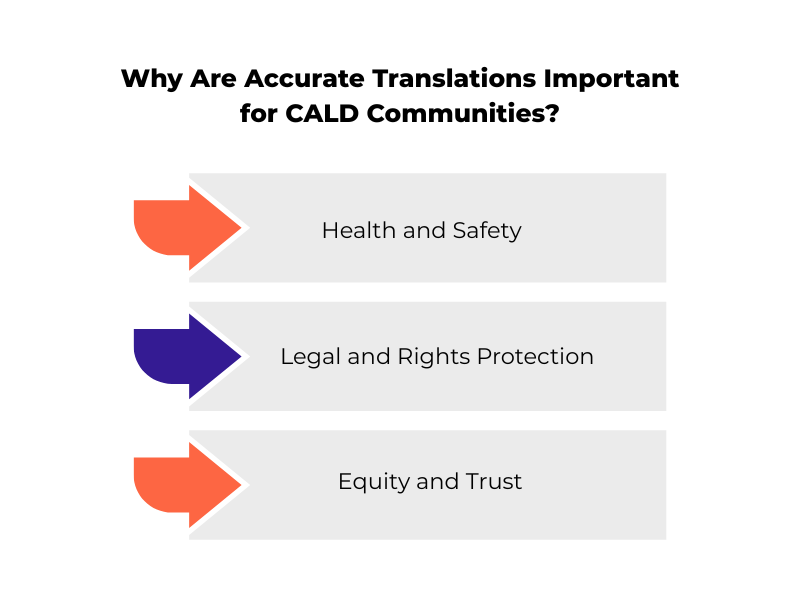
There are numerous reasons accurate translations are important for CALD communities. Here’s a look at a few of the major ones:
Health and Safety
Accurate translations help prevent medical errors that might lead to misdiagnosis and incorrect treatments. Additionally, a properly translated medical document can help people understand the correct ways to take care of themselves and navigate local health systems. Furthermore, accurate emergency and public health alerts ensure that safety rules are followed properly during crises.
Legal and Rights Protection
Inaccurate translations of contracts or court notices can lead people to miss vital deadlines or accidentally break laws. Proper translations help prevent immigration applications from being delayed or wrongly rejected. Also, accurate translations are necessary to ensure people have the correct details of what they are signing or buying. This is where hiring a NAATI translator becomes essential.
Equity and Trust
Accurate translations ensure the proper use of local idioms, correct tones, and respectful phrasing, instead of confusing word-for-word translations. This helps in making official messages believable and useful to the communities.
A Natural Hazards Research Australia report into the 2022 South East Queensland floods found that people from culturally and linguistically diverse communities are more at risk when the emergency information is hard to interpret.
The reports were the same during the 2022 Victorian floods in Shepparton, where ABC News reported that the local communities had to act rapidly to translate emergency warnings into languages like Fijian, Samoan, and Turkish.
Accurate translations not culturally appropriate for CALD fail to achieve their purpose.
What Are the Common Mistakes in CALD Community Translations?
We have talked about the reasons translations for these communities fail. The common mistakes that lead to such failures are:
Literal Translations
Literal translations of idioms, slang, or complex English phrases often lead to inaccuracies, and the translations fail to convey the intended message. Using automated tools to translate the messages often leads to such errors. It is, therefore, recommended to use professional translation services in these cases.
Cultural and Contextual Blunders
Translating without cultural and contextual understanding leads to problems. People often make the mistake of directly translating the text without knowing the cultural nuances. This is a major problem when it comes to CALD communities.
Technical and Layout Errors
A major mistake tools and word-for-word translators make is that they cut off the text strings because the translated language needs more space on the page or the screen than the source language.
Also, the mistake of using standard fonts for non-Latin scripts leads to broken characters or unreadable squares, which can make the translation unclear. The cultural diversity in Australia points to the need for translations that are readable by different communities.
But how to test if these translations are culturally appropriate or not?
How Do You Test Cultural Appropriateness in Translation?
It is crucial to learn the correct ways to test translations for cultural appropriateness. The process involves using local expert panels, conducting cognitive interviews with target audiences, and performing in-field pilot testing or community checking. Here’s how you can do that:
- Expert Review Panels
- Get a team of in-community bilingual reviewers based in Australia
- Evaluate idioms, symbols, and tone instead of literal wording
- Identify the potential risks for brands or political taboos
- Cognitive Interviews
- Interview a small group of people from the community
- Ask them what the phrases mean to them
- Check for any type of confusion, awkward phrasing, or double meaning
- Pilot Field Testing
- Trial the translated content in a real-world setting or focus group
- Adjust the translated text based on the feedback of the users and local engagement
You need to understand the difference between literal translation vs cultural adaptation before implementing the test methods.
What Makes a Translation Culturally Appropriate for CALD Communities?
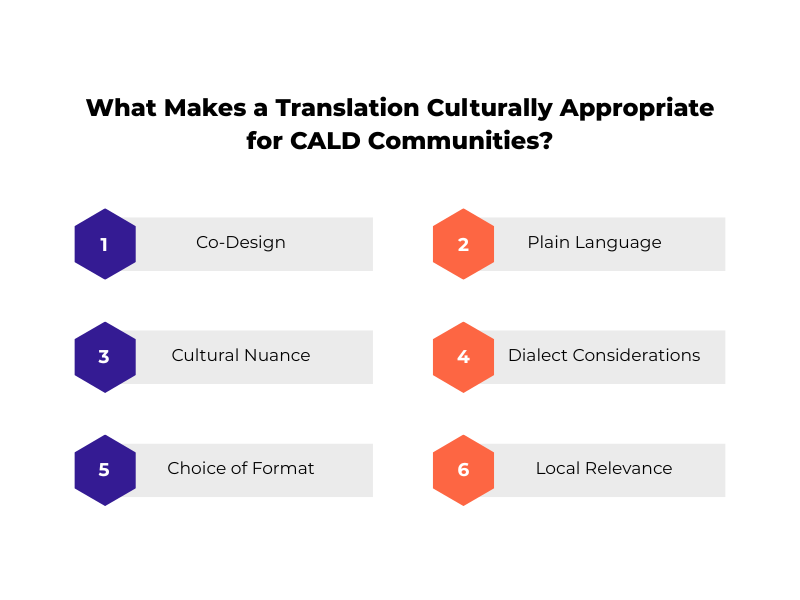
There are a few things that can help make a translation culturally appropriate for CALD communities.
Co-Design
Involving target community members in the creation and review process from the start can help make the translations accurate and culturally appropriate.
Plain Language
Instead of targeting complex jargon, it is wiser to match the general literacy and levels of health literacy in CALD communities. This would help convey the message clearly to the target audience.
Cultural Nuance
Understand and adapt the local idioms, concepts, and graphics to ensure the translated content respects local beliefs, values, and social norms.
Dialect Considerations
You need to check if distinct dialects or spoken variants are necessary instead of a generalised single written translation.
Choice of Format
You must assess and understand which format works well for the target audience: printed text, audio, or visual/multimedia formats.
Local Relevance
Make sure the translated content addresses the specific realities of the target audience’s local environment instead of using generic overseas phrasing.
What Is the Difference between Translation and Transcreation for CALD?
Here’s a look at translation vs transcreation for CALD communities:
| Feature | Translation | Transcreation |
| Primary Goal | Faithful factual accuracy | Cultural and emotional impact |
| Approach | Word-for-word linguistic matching | Concept-by-concept recreation |
| Creative Freedom | Low | High |
| Cultural Nuance | Preserves source style | Replaces source with local idioms |
| Content Focus | Text and literal meaning | Tone, imagery, and intent |
| Best Used for | Medical, legal, and safety forms | Marketing, health campaigns, and ads |
This helps you understand when you need translation and when you will need transcreation.
Final Thoughts
Translating for CALD communities needs a proper understanding of cultural nuances, metaphors, idioms, and more. Since automated tools or word-for-word translators do not understand these, even accurate translations fail for this community.
The best way to go about it is to hire a professional translator, well-versed in the language and culture. It will ensure that the message is conveyed correctly and that the people from the community understand the same.

- Overseas Grade Conversion Australia: Why Translators Can’t Convert Your Grades - September 21, 2026
- Bilingual Staff vs Professional Translators: The Risks Nobody Talks About - September 2, 2026
- How Professional Translators Maintain Accuracy Across Different Languages - August 26, 2026