
Australia’s consumer market is regulated with strict standards. If your product label does not meet these standards, it will not reach the shelves.
Over 3,400 product safety recalls were issued in Australia between 2019 and 2023. Many cases involved non-compliant labelling. Australia has a multicultural population, which creates a demand for translation in multiple languages, particularly in food, pharmaceuticals, and cosmetics.
When you translate your product labels, you are not just converting text from one language to another.
You have to follow a framework governed by the Therapeutic Goods Administration (TGA), the Australian Competition and Consumer Commission (ACCC), and Food Standards Australia New Zealand (FSANZ). In this guide, we will discuss how to translate product labels.
Table of Contents
ToggleKey Takeaways
- Label translation of the product must meet TGA, ACCC, and FSANZ standards, depending on your product type.
- All important label information should be in English. Other languages are acceptable, but they cannot replace English.
- Adaptation of culture and doing packaging translation right are important.
- Use a hybrid approach, machine learning for drafts and human review for compliance.
- Working with certified translators and ISO-certified translation services reduces your regulatory risk.
What Is Product Label Translation?

Product label translation converts the text present on your product packaging to another language. It needs to preserve the legal meaning, regulatory compliance, and consumer clarity. For the Australian market, this process is tough as it needs an understanding of local labelling laws, cultural preferences, and product-specific regulations.
The goal is not just to make the text readable in another language. The product packaging translation should also follow the Australian product label compliance format and font requirements. It is necessary to use terms that regulators and consumers in Australia actually recognise.
Why Label Translation Goes Beyond Word-for-Word Conversion?
You will have to translate directly. Word-for-word translations work, but they fail in practice. The regulatory bodies require specific terminology in approved formats.
For example, a pharmaceutical product label should use the TGA-approved language convention for active ingredients. A food product must display allergen information according to FSANZ Standard 1.2.3. Translating these elements needs knowledge of both the source language and industry-specific label compliance rules.
Benefits of Accurate Label Translation for the Australian Market
- It allows for smooth market entry with fewer regulatory delays.
- Labelling helps in building brand trust with Australia’s consumer base.
- Lessen the risk of fines, bans, and regulatory non-compliance.
- Supports consumer safety by following instructions and warnings.
- fStrengthens your position to translate product labels for export.
Key Components of Effective Packaging Localisation
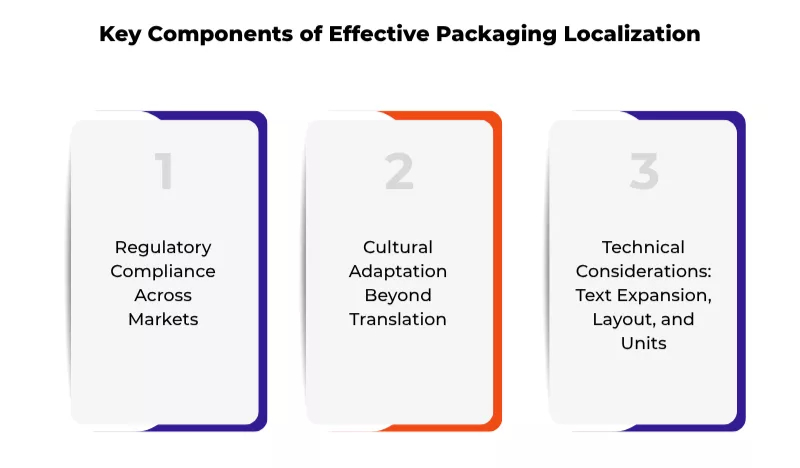
Packaging and label translation involve several layers of work. Text conversion is just the starting point. It requires multilingual product labelling. Effective localisation for the Australian market covers compliance, cultural adaptation, and technical execution.
Regulatory Compliance Across Markets
Every product category in Australia works under its own regulatory framework. If you translate incorrectly, then it can cause:
- Product ban
- Heavy fine
- Mandatory recall
So, before you start translating, check which regulatory body governs your product and what the body requires on the label. Regulatory compliance is not the final step.
Cultural Adaptation Beyond Translation
Localised labelling needs more than linguistic accuracy. It needs cultural sensitivity. Color psychology, symbols, and marketing slogans all carry different meanings across cultures.
Technical Considerations: Text Expansion, Layout, and Units
Translation changes the physical length of the text. German, for example, needs 30% more space than English. Such issues increase the production costs and design timelines.
You need to include the translator in the packaging design process to avoid costly redesigns. Australia has the metric system. All the labels should be converted to metric, grams, millilitres, and degrees Celsius.
How to Translate Product Labels Correctly?
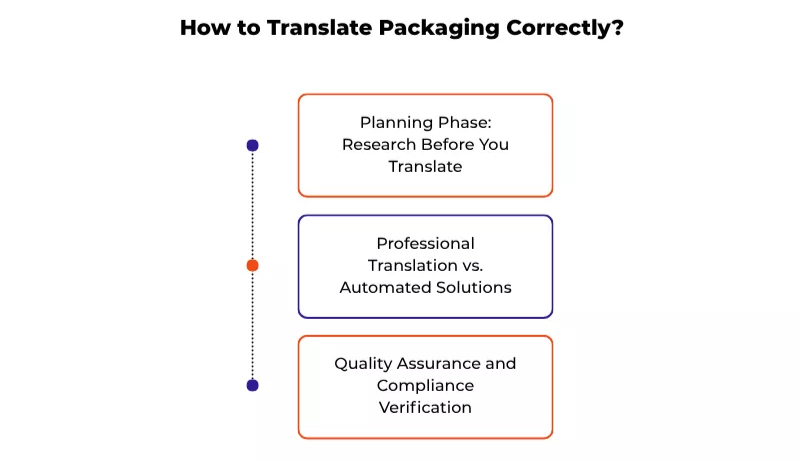
Translating packaging correctly needs a structured process. The following things help you avoid the most common and costly mistakes:
Planning Phase: Research Before You Translate
Start with market research. Understand which regulatory body governs it. For most of the product categories, English is the required language. But certified translations into other languages are needed for bilingual communities.
Professional Translation vs. Automated Solutions
AI-powered translation tools are improving, but packaging translation needs human expertise in the target market. It is specific to products regulated by the TGA or ACCC consumer law.
Machine translation can only speed up the initial stage. But human translators should look for cultural adaptation and compliance verification. For pharmaceutical and medical device labels, using a certified translator with relevant industry experience is strongly recommended. For pharmaceutical and medical device labels, using a NAATI translator with relevant industry experience is strongly recommended.
Automated solutions like Google Translate are not right for product label compliance work. They do not have the in-depth knowledge of Australian packaging language requirements that professional human translators bring.
Quality Assurance and Compliance Verification
Build a multi-stage review process into every label translation project. Each stage should involve a different type of reviewer:
- A native-speaker linguist checks language accuracy and tone.
- An industry specialist looks up the correctness of technical terminology.
- A legal or regulatory expert verifies compliance with TGA, ACCC, or FSANZ requirements.
Testing with native speakers from your target community is also valuable. Focus groups can identify misunderstandings or design issues before you go to market. This investment is small compared to the cost of a product recall.
Common Packaging Translation Mistakes to Avoid

Errors in packaging translation are expensive. They can delay market entry, trigger regulatory action, or damage your brand reputation. These are the most common mistakes and how to avoid them.
Literal Translation Errors
Word-for-word translation fails in a regulatory context. All these descriptions need precise adaptation. They don’t need literal conversion.
A well-known example from international labelling: a brand’s slogan translated literally into Chinese resulted in a meaning completely opposite to the original. The same risk applies to any market. Always use professional translators with in-depth knowledge of the target language.
Technical terminology is also important. Ingredient names, measurement units, and safety instructions must use the accepted, legally recognised terms in Australia. Using an unofficial or regional term can make a label non-compliant.
Inadequate Regulatory Research
When you overlook Australian labelling requirements before starting translation, it leads to expensive corrections. Each product category has different rules. A cosmetics label has different mandatory elements from a pharmaceutical label. A food product has different requirements from a cleaning product.
Create a regulatory checklist for your specific product before briefing your translation team. Include:
- The relevant regulatory authority (TGA, ACCC, FSANZ, AICIS)
- Mandatory elements required by law
- Any product category-specific formatting requirements (e.g., minimum font size)
- Country of origin obligations
- Required warning statements and their approved wording
Ignoring Cultural Preferences and Visual Elements
It is an expensive error to think that what worked as a label in one market will be effective in another. The multicultural population in Australia has a wide range of cultural tastes that affect the reception of packaging. There are cultural connotations of colours, symbols, and images.
Consult cultural advisors or local marketing experts to confirm design options prior to finalising packaging. This will avoid the mistake of cultural misinterpretations. It may make your target audience feel out of place, despite the text being translated spot on.
6 Tips for Translating Labels for the Australian Market

These practical tips will help you manage your label translation project effectively and meet Australian compliance standards.
Tip 1: Work with Translators Who Know Australian Regulations
Not all translators understand every regulatory environment.
- For TGA-regulated products, look for translators with pharmaceutical or medical device experience.
- For food labels, choose translators familiar with FSANZ requirements.
- Certified translators are generally preferred for official label compliance work in Australia.
Using translation services with ISO certification gives you an additional layer of quality assurance.
Tip 2: Plan for Text Expansion and Layout Changes Early
Involve your translation team at all times prior to finalising the packaging design. Other languages, such as German, Italian, and Arabic, take up a lot of space compared to English. If you design the label first and translate later, you will face costly redesigns. Create dynamic label designs that can be expanded with text in multiple target languages.
Tip 3: Use Australian English, Not British or American English
The spelling, terminology, and phrasing of Australian English are different. Other words, such as colour, aluminium, litre, and fibre, are spelled in the Australian way.
Regulatory documents and consumer-facing content should be written in Australian English to avoid confusion, as well as to be of the professional standard that Australian regulators and consumers expect.
Tip 4: Build a Centralised Glossary for Consistency
Make a translation glossary for the product range. It records approved translations of technical terminology, ingredient names, warning texts, and brand language. This glossary will serve as a guideline to all translators and reviewers of your labels.
It guarantees uniformity between various product lines and avoids various translators referring to the same concept by different terms, a frequent and preventable source of compliance risk.
Tip 5: Run a Multi-Stage Review Process
Regulatory label work cannot be done by a single-pass review of translation. The review process must include at least three steps: linguistic review by a native speaker, technical review by an industry expert, and compliance review by a regulatory expert who is knowledgeable about the Australian labelling law.
With high-risk groups like pharmaceuticals or medical devices, add a final signature on behalf of your Australian sponsor or regulatory affairs department. Getting this done perfectly needs medical terminology translation services. It might go wrong if you do not pay attention to it.
Tip 6: Stay Updated on TGA and ACCC Requirement Changes
Australian labelling regulations change. The TGA updates its guidance regularly, and the ACCC product labelling standards review mandatory safety standards and country of origin labelling rules.
Subscribe to TGA and ACCC regulatory update alerts and build a process to review your label translations whenever relevant regulations change. A translated label that is compliant today may become non-compliant after a regulatory update.
Conclusion
Product label translation to the Australian market is a process that is critical to compliance. It involves proper translation services, proper interpretation of TGA, ACCC, and FSANZ requirements, and proper cultural and technical adaptation. Errors in label translation are not only embarrassing but also potentially expensive, legally binding, and even damaging to consumers.
The best methodology is to incorporate a combination of professional human translators (preferably certified and with experience in the industry) with a structured quality assurance mechanism, which involves linguistic, technical, and regulatory checking.
By investing in this process, you are able to secure your business and your products have the best opportunity of succeeding in the Australian market.
Begin your label translation process early, develop a glossary, adhere to the relevant regulatory framework of the particular category of your product, and use translation services that are familiar with the Australian regulatory environment. The outcome is a translated label that gains consumer confidence and all legal specifications.
Frequently Asked Questions
Does Australia require product labels to be in English only?
What happens if my product label does not comply with TGA requirements?
Can I use the same translated label for Australia and New Zealand?
How do I find a translator with TGA and ACCC regulatory knowledge?

- Communicating with Aboriginal and Torres Strait Islander Communities - August 4, 2026
- Community Checking in Translation: Testing Translations before Launch - July 28, 2026
- Can You Translate Your Own Documents for Immigration? - June 22, 2026