
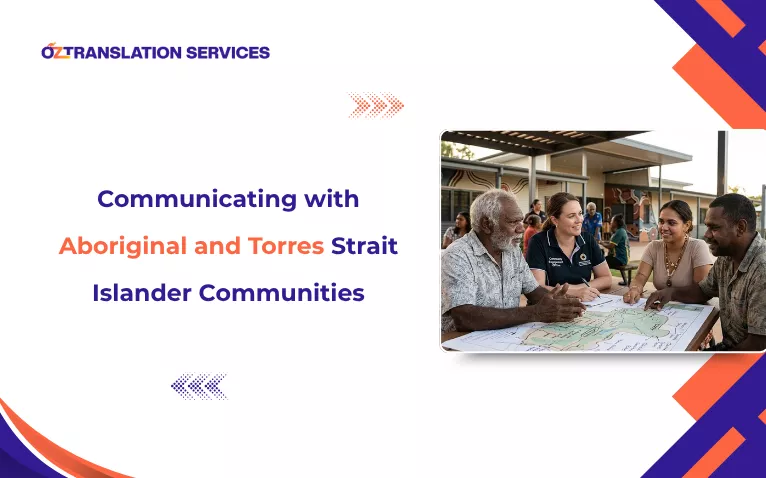
In the present world dominated by Western culture, the Aboriginal and Torres Strait Islander community remains a marginalised group with many social and economic disadvantages. Moreover, the negative impact of past government policies, such as family separation, land segregation, and regional displacement, led to the mistrust held by Indigenous people of this minority group towards government services and systems.
When it comes to health, education, employment, and housing access, Aboriginal and Torres Strait Islander people experience significantly varied outcomes. These people still face inequality, racism, and discrimination.
Therefore, communicating with Aboriginal and Torres Strait Islander Communities requires reflection without judgement, as their beliefs, values, worldviews, and experiences are different from those of other Australians. Cultural beliefs, values, and worldviews influence how a person thinks, behaves, and interacts with others.
This article discusses how to establish a culturally sensitive interaction effectively with Aboriginal and Torres Strait Islander people. We have also shared an action plan to maintain cultural safety while working respectfully with Aboriginal communities.
Table of Contents
ToggleKey Takeaways on Aboriginal and Torres Strait Islander Communication
- Aboriginal and Torres Strait Islander communities comprise First Nations peoples who speak Aboriginal English and Torres Strait Creole.
- Ensuring cultural safety while communicating with Aboriginal and Torres Strait Islander People is essential for secure and inclusive cultural communication.
- Acknowledgement of Country and Welcome to Country are important cultural formalities for public events and official on-Country engagement.
- Important interaction protocols include respect, rapport building, yarning, active listening, privacy, empathy, etc.
- Drawing on Indigenous communications services and professional Indigenous language interpreters Australia-wide often makes the interaction more manageable and safer.
What Is Cultural Safety for Aboriginal and Torres Strait Islander People?
Cultural safety for Aboriginal communities means ensuring an environment where people feel valued, respected, and safe. There is no challenge or denial of their identity or experiences. It is determined by the person receiving the service, not the person providing it.
Core Principles of Ensuring Cultural Safety
- No judgement and no racism.
- No discrimination, bias or offensive behaviour.
- Recognising and fixing power imbalances between the dominant culture and Indigenous individuals.
- Supporting the decision-making rights of Indigenous people about their own lives and care.
- Respecting identity and unique cultural backgrounds without assault or criticism.
Understanding the Language for Communicating with Aboriginal and Torres Strait Islander Communities
The first step towards communicating with Aboriginal and Torres Strait Islander Communities is understanding: How many Aboriginal languages are there, and what language do Torres Strait Islander people speak?
Before 1788, Australia had more than 250 distinct Aboriginal languages (with around 800 dialects). Today, according to the NILS4 Latest Data (2025–26), roughly 177 of these languages are still actively spoken, while most are considered endangered.
Many Aboriginal people do not speak English as their first language. Some also speak English in different dialects, such as Kriol and Aboriginal English. There are two traditional Indigenous languages in which Torres Strait Islander people speak:
- Kala Lagaw Ya: Spoken mainly in the western and central islands. It connects to the Pama-Nyungan language family of mainland Australia.
- Meriam Mir: Spoken in the eastern islands. It belongs to the Trans-Fly languages of New Guinea.
Apart from these, they also speak an English-based creole called Yumplatok (Ailan Tok), also known as Torres Strait Creole. It is the most common everyday language used across the islands.
Here’s the latest data on the most spoken First Nations languages:
| Language | Primary Region | Speakers (2021 Census) | Share of Indigenous-language speakers |
| Yumplatok (Torres Strait Creole) | Torres Strait Islands / QLD | 7,596 | 9.9% |
| Kriol | Northern Australia (cross-border) | 7,403 | 9.6% |
| Djambarrpuyngu | Northeast Arnhem Land (NT) | 3,839 | 5.0% |
| Pitjantjatjara | WA / SA / NT borders | 3,399 | 4.4% |
| Aboriginal English | National | 1,371 | 1.8% |
Source: ABS, Language Statistics for Aboriginal and Torres Strait Islander Peoples, 2021 Census (released 25 October 2022). Total: 76,978 speakers — 52,139 traditional languages, 15,026 new contact languages, 1,371 Aboriginal English.
What Is the Difference Between the Acknowledgement of Country and Welcome to Country?

Understanding the cultural significance of Acknowledgement of Country and Welcome to Country is important when the interaction is taking place officially. Let’s understand both:
1. What Is an Acknowledgement of Country?
When inviting the Aboriginal and Torres Strait Islander people to a meeting, gathering, or event, Acknowledgement of Country is a respectful way to show welcome.
It is an official opening statement paying tribute to the Traditional Custodians of the specific geographic area where the meeting is taking place. It is a formal way of showing respect to the ongoing spiritual, physical, and cultural connection that First Nations people hold to their ancestral lands and waters.
The statement can be delivered by any individual, Indigenous (the prime guest) or non-Indigenous (the authorised host).
How to Conduct an Acknowledgement of Country?
The Acknowledgement of Country must be the first item on the agenda at any corporate or public event. Here are some practical tips to make sure everything goes right:
- Research the Traditional Owner: Find the specific name of the Aboriginal or Torres Strait Islander Nation, language group, or clan where you are meeting. Check local council websites, the AIATSIS Map of Indigenous Australia, AIATSIS AustLang, or the National Native Title Tribunal to verify the correct names.
- Choose the Right Structure: A proper Acknowledgement follows a simple three-part structure:
- The Name: Name the specific Traditional Custodians of the local land.
- The Respect: Pay respect to their Elders—past, present, and emerging. Pay respect to any First Nations people attending or listening.
- The Connection: Recognise their continuous, unbroken connection to the land, waters, and community.
Sample wording:
Before we begin, I would like to acknowledge the [Name of Traditional Owners] people of the [Name of Nation] Nation, the Traditional Custodians of the land on which we meet today. I pay my respects to their Elders past, present, and emerging. I also extend that respect to any Aboriginal and Torres Strait Islander peoples here with us today and recognise their ongoing connection to land, waters, and community.
Note: Practice the correct pronunciation of local names before the event and use the present tense.
iii. Employ Language Services for Aboriginal and Torres Strait Islander Communities: Working with an interpreting and translation service provider to convert the speech material into the Indigenous language of the target group (with the community’s consent) shows linguistic respect towards the community.
2. What Is a Welcome to Country?
When visiting an ancestral land of the Aboriginal and Torres Strait Islander community, a cultural ritual, Welcome to Country, takes place. It is a formal cultural ritual performed by the Indigenous people to welcome authorised visitors onto their land. It is an age-old practice with deep significance to grant safe passage and offer spiritual protection to travelling neighbours and guests.
Depending on the location, the specific Nation’s traditions, and the scale of the event, a Welcome to Country can take several forms:
- A Spoken Speech: The Elder shares stories of the land, explains its history, and formally offers safe passage to the attendees.
- Song and Dance: Traditional performers may use song, didgeridoo/yidaki music, and dance to welcome the crowd.
- A Smoking Ceremony: The Elder burns native plants (like eucalyptus) to produce smoke. This smoke is used to ward off bad spirits, cleanse the space, and bless the participants.
How to Conduct a Welcome to Country and Acknowledgement of Country?
Welcome to Country is a sacred cultural ritual. It can only be performed by a Traditional Owner or Elder who belongs to the specific land you are meeting on. However, the authorised host can formally arrange and facilitate it. Here are some tips:
- Find a Community Leader or Local Elder and Book a Consultation: You can find a local Elder or a community leader with the help of a community research team. You can also contact your local Aboriginal Land Council or native title body to find the right Traditional Owners of the specific area. Book a consultation to discuss the needs by reaching out in advance (weeks or months before your event). Elders are highly respected and have busy schedules.
- Discuss the Format: Ask the Elder what element they plan to provide, such as a formal speech, a traditional song, or a physical smoking ceremony.
iii. Pay the Fee: A Welcome to Country is professional cultural work. Provide fair financial compensation (an honorarium) to the Elder or their representative organisation.
What Are the Cultural Protocols When Engaging Aboriginal Communities?

Understanding cultural protocols for Indigenous communities is important for respectful communication with Torres Strait Islander people. Here are some important tips for communicating with Aboriginal communities while acknowledging their perspective without hurting their cultural sentiments:
1. Initial Greetings and Building a Rapport
Many Aboriginal and Torres Strait Islander communities appreciate relational introductions. It helps them to establish trust and build a transparent connection. To build and maintain long-term rapport, considering a ‘person before business’ approach is important.
- During initial greetings, introduce yourself in a warm and friendly way. State your first and last name, along with your family’s cultural lineage and geographic heritage.
- Always go for a soft handshake when meeting face-to-face. Avoid a firm, aggressive settler grip.
- Share stories about yourself.
- Ask about people and where they are from.
- Discuss other topics of common interest.
How Do You Address an Aboriginal Elder? Addressing with Titles
In local culture, addressing someone older with “aunty” or “uncle” is a common practice to show respect, even if the person is not a blood relative or necessarily an Elder. However, for professional interactions, only address people with these titles if approval is given and/or a positive relationship exists.
2. Clear Interactions Through Simple Word Exchange
For some people — particularly in remote communities — English is a second, third, or fourth language, so meaning can be lost even when a conversation appears to be going well. To overcome communication barriers, you have to be clear and straightforward in your approach. Here are some tips:
- Avoid using complex words or jargon.
- Take help from widely available plain-language resources for Indigenous communities.
- Ask to confirm whether you have understood the right meaning of the words used by the person and vice versa.
- Avoid using traditional languages or creole words unless you have high proficiency and understanding.
- While explaining concepts, sharing instructions or introducing terms, use visual aids like diagrams, models, short videos, and images to simplify.
- If required, seek help from Aboriginal and Torres Strait Islander interpreter services or local staff.
Make sure your instructions are full and clear, so there is no room for confusion. For example, if you just say ‘take until finished,’ someone might think they can stop once they feel better, rather than finishing every single pill in the bottle. The same ambiguity causes problems in written material, which is why our guide to the mistakes to avoid in government translation starts with instructions that assume too much.
3. Questioning without Intimidating
While questioning Aboriginal or Torres Strait Islander people, you need to make them feel culturally safe. Direct questioning often leads to:
- Intimidation and discouragement of participation
- Misunderstanding
- Difficulty in obtaining important information
Therefore, indirect questioning is the better approach. Here’s what to do:
- First, explain why you need to ask any questions.
- Use a “roundabout” way of asking. (e.g., “I was wondering about your family…” instead of “How many kids do you have?”).
- Avoid compound questions (e.g., “How often do you visit your GP and what are the reasons that you don’t?”).
- Don’t force the person to repeat themselves.
- Avoid using hypothetical examples.
- Use plain words (e.g., say “enough” instead of “sufficient”).
4. Dealing with Repeated “Yes”
Aboriginal and Torres Strait Islander people may answer questions the way they think others want. They also tend to agree with the questions even when they do not understand or agree. They do it simply to end the conversation or when they feel uncomfortable.
Therefore, take time to strengthen the rapport through initial interactions to make them feel comfortable and interested. Always explain how long you will take up their time at the beginning. Also, give the person a chance to question back.
5. Acknowledging Sensitive Emotions: “Shame”
The emotions of “Shame” and “Shyness” are deeply felt sentiments among Aboriginal and Torres Strait Islander people. They might feel ashamed or embarrassed to answer some questions where they have to share
- Private or personal information
- Cultural beliefs
- Family situations
To make them feel their confidentiality is not breached, you can do the following:
- Talk discreetly in a safe environment to make them feel comfortable
- Avoid open or public discussions for sensitive matters
- Consider Men’s and Women’s Business. (E.g., allow your female agent to talk with an Indigenous woman).
Private and compassionate communication styles help in building trust with Aboriginal and Torres Strait Islander communities
6. Active Listening and Allow Time for Silence
Active listening is important while communicating with Aboriginal and Torres Strait Islander people. These people may struggle to communicate due to linguistic differences. Here’s what to do:
- Let people take the necessary time to explain or answer.
- Remain silent as they talk. This shows respect for the person’s decision to participate.
- Avoid selective hearing. Do not continually interrupt or speak over the person.
- Show empathy and be attentive to make them feel heard and understood.
- Repeat what they said by paraphrasing or summarising, signalling that you are listening to them. This also helps with clarification.
On the other hand, extended periods of silence during conversations are a cultural norm in Aboriginal and Torres Strait Islander culture. Be respectful and do not misinterpret their silence as a lack of understanding or agreement, or as the absence of concerns. Instead, try to understand their silence by observing their body language.
This helps you gauge when it is appropriate to start speaking. You can also seek clarification if they understood the topic discussed or the question asked.
7. Understanding Non-verbal Communication Cues
Aboriginal and Torres Strait Islander people may use certain non-verbal communication cues, such as hand gestures or facial expressions. These often might have different meanings in the Western context.
Conversely, your own non-verbal communication and behaviour will also be observed and interpreted. For example, if your body language reflects the feeling of annoyance, it is likely to be noticed by the people.
8. Perception of Eye Contact
In Western culture, avoidance of eye contact is viewed as dishonesty, rudeness, or lack of interest. But in some Aboriginal and Torres Strait Islander communities, it is often the opposite. Avoidance of eye contact is customarily a gesture of respect. Direct eye contact may be perceived as rude, disrespectful, or even aggressive.
To maintain a polite and respectful attitude, averting or lowering your eyes during conversation is a recommended approach. Study the opposite person’s body language and follow their lead to modify eye contact accordingly.
Unless the person initiates it and is comfortable, avoid cross-gender eye contact.
9. Personal Space & Touch
Maintain a respectful physical distance. Being too close to an unfamiliar person or the opposite gender can lead to discomfort or a feeling of being threatened.
If dealing with Torres Strait Islander patients and physical contact is necessary, first establish a rapport. Explain why you need to touch them, and always seek their consent.
10. Offering Options and Ownership for Decision Making
Allow people to choose among options for their own benefit. For example, if providing primary health care services, present them with medication options for oral and injection methods.
Important considerations:
- Options must be practical and realistic.
- Avoid making solid promises. Failing to deliver leads to mistrust again.
Next, respect their decision-making process. Indigenous communities have kinship structures and relationships. Final decisions are often made after taking input from all family members.
Here’s what you need to do:
- Give the person time if they need to consult with their family.
- Let them take sufficient time to clearly understand their options.
- Be respectful of their privacy if you are asked to leave the room or meeting when the family needs to discuss the matter privately.
Conclusion
Effective communication with Aboriginal and Torres Strait Islander communities is built on a foundation of genuine trust and deep respect for culture and Country. By taking the time to listen, following local protocols, and ensuring cultural safety, we can build stronger, more inclusive connections.
Frequently Asked Questions
What is the correct term for Aboriginal and Torres Strait Islander people?
The most respectful and correct collective terms are Aboriginal and Torres Strait Islander peoples or First Nations peoples.
Why is it disrespectful to say a deceased person's name?
In many Aboriginal and Torres Strait Islander communities, mentioning the name of a deceased person is often taboo. It is rooted in the cultural belief that doing so can disturb the spirit or cause interruption in their afterlife journey, or accidentally call the spirit back to the mortal world.
What is yarning in Aboriginal culture?
Yarning is an informal, collaborative, and respectful way of sharing stories, knowledge, and life experiences. It helps to build trusting relationships, pass down history and culture, and solve problems through open, non-linear dialogue rather than rigid questioning.
What is kinship in Aboriginal culture?
Aboriginal and Torres Strait Islander cultures have a complex, holistic social system of kinship. It sets out boundaries, responsibilities and rules for marriage, and underpins a profound spiritual relationship with Country (land, water and sky). It serves as the foundation for respect, behaviour and mutual obligation.
What Should Culturally Informed Community Checking Include for Aboriginal and Torres Strait Islander Communications?
Culturally informed community checking for Aboriginal and Torres Strait Islander communications must include
- Genuine partnership
- Local governance consultation
- Iterative feedback loops
The goal is to ensure messages are culturally safe, accurate, and respectful of community contexts and intellectual property.
Why is it important to use Aboriginal Interpreters for Respectful Cultural Communication?
Cultural communication using Aboriginal and Torres Strait Islander interpreters is important for the following reasons:
- Ensures the meaning of the message is accurately conveyed
- Values and acknowledges the complex kinship system
- Bridges different worldviews
- Establishes essential trust
They prevent dangerous misunderstandings and empower communities through culturally safe dialogue.
Are there any companies specialising in Aboriginal and Torres Strait Islander community engagement?
OZ Translation Services is one of the companies that specialise in Aboriginal and Torres Strait Islander community engagement. We have a dedicated team of NAATI-certified translators and interpreters, and we work with community leaders and Traditional Owner organisations to facilitate Aboriginal and Torres Strait Islander engagement events, workshops and campaigns.
Are there consultancies that provide cultural awareness training for working with Aboriginal and Torres Strait Islander communities?
Several Australian consultancies and organisations offer specific cultural awareness and competency training for working with Aboriginal and Torres Strait Islander peoples. Organisations offering this training include:
- Arrilla Indigenous Consulting
- Evolve Communities
- Indigenous Allied Health Australia (IAHA)
- Victorian Aboriginal Child Care Agency (VACCA)
How do Indigenous Communications Services Improve Communication with Aboriginal and Torres Strait Islander Communities?
Indigenous Communications Services improve engagement with Aboriginal and Torres Strait Islander communities by
- Centring cultural safety
- Employing local languages
- Utilising Indigenous-led media
These specialised services replace top-down government messaging with trusted, two-way dialogue, honouring community protocols, oral traditions, and self-determination.

- DFAT Authentication vs Apostille in Australia: Which Certificate Do You Need? - September 9, 2026
- Communicating with Aboriginal and Torres Strait Islander Communities - August 4, 2026
- Community Checking in Translation: Testing Translations before Launch - July 28, 2026