
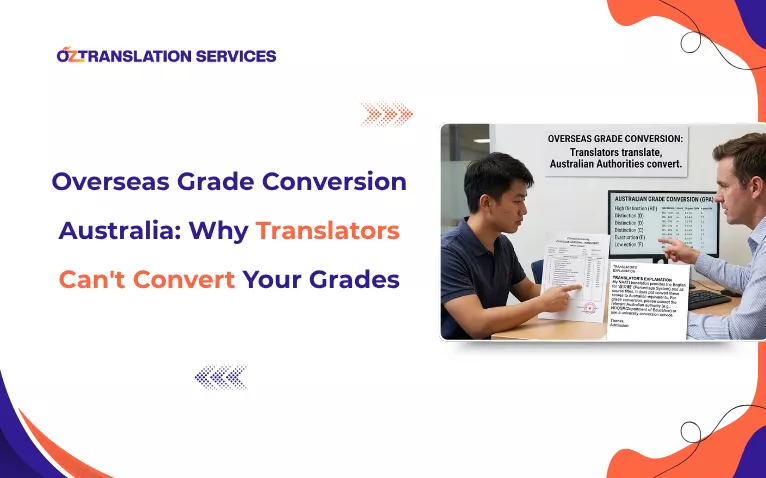
Wondering how to convert your grade points in Australia? You can translate your academic transcript, but you can’t translate grades. First, this is not the role of translators. They can only render the words, titles, remarks, and other information accurately into English. But deciding whether your 75% equals a distinction or what your 3.5 GPA equates to on an Australian scale is outside their job responsibility. There are separate bodies that conduct the process of overseas grade conversion Australia. Grade conversion isn’t a language exercise; it requires an overseas qualifications skills assessment. In this blog, you can check in detail what a translator can do and who can convert overseas grades.
Table of Contents
ToggleKey Takeaways on GPA Conversion Australian Universities
- NAATI translators can only translate the transcript into English. They cannot convert overseas grades as per Australian standards, as they focus on language accuracy and comply with the AUSIT code of ethics.
- It is important to know what a certified translator can and cannot do – adjust wording and phrasing, annotate non-text elements, certify the document, etc. Credential assessment is carried out by bodies such as VETASSESS and the Australian Government Department of Education, etc.
- GPA, WAM, grade, and qualification equivalence measure different things and are not interchangeable.
- A translated academic transcript can also be rejected for reasons such as an uncertified translation, missing notarisation, or no credential evaluation report.
Can a NAATI Translator Convert My Overseas GPA into An Australian Grade?

No. Translation and the GPA conversion Australian universities follow are two distinct processes. They are also handled differently, as they are two fundamentally different jobs. A NAATI-certified translator renders the transcript into Australian English in line with academic transcript translation rules — same subject titles, same grades, same notations — without changing or interpreting anything.
A translator cannot carry out overseas grade conversion Australia for these reasons:
- A translator is trained in language accuracy, not in the qualification recognition Australian process.
- A translator’s job is to preserve the source record faithfully. Therefore, converting a foreign grade into an Australian one can undermine the document’s reliability.
- NAATI-certified translators work under the AUSIT code of ethics, which requires accuracy and impartiality, rendering the source faithfully rather than interpreting it.
- There is a dedicated process for transcript grade equivalency Australia, which is handled by the credit assessment team of the university.
- Moreover, if the translator could also perform the equivalency assessment, there would be no independent checks, and the process could be used to inflate results.
A translator translates a document, and a separate assessor completes the equivalency assessment. NAATI accreditation is what makes a translation acceptable for official use in Australia. It has no bearing on grade conversion.
Is It a Problem If My Translated Transcript Shows Percentages Instead of a GPA?
Not necessarily. A translated transcript showing percentages instead of a GPA is not automatically a problem if the original transcript reports marks as a percentage. A translator should not convert your percentage to an Australian GPA just because a conversion chart exists online.
A percentage and a GPA are not interchangeable, and you should not assume that the recipient will convert them automatically.
Your translated transcript may be fine if:
- The translation accurately reproduces those grades.
- The receiving university accepts percentage-based transcripts.
- You have not been asked to provide a separate GPA or grading assessment.
However, the percentages could cause a problem if:
- Your application form says “GPA required” and your translated transcript only shows percentages.
- The translation removes the original grading information.
Also, no universal percentage-to-GPA conversion applies safely to every Australian university.
What Can a Certified Translator Change?
A NAATI-certified translator follows professional standards and academic transcript translation rules to ensure the translation is suitable for official use in Australia. Whether it’s degree certificate translation or personal documents, they can change:
Wording and Phrasing
In running text, a translator may adjust wording so it reads naturally in English, while reproducing subject titles, grades, and notations exactly. They can also replace literal wording with an accurate equivalent, adjust grammar, sentence order, and tense, and easily convert non-English documents for government applications.
Layout Adaptation
NAATI translators can also adjust the document layout to make it clearer and more readable. They reproduce the source layout as closely as possible, adjusting spacing, line breaks, and label placement where the translated text runs longer or shorter.
Annotate Non-Text Elements
A translator also identifies and describes visual elements in the original document which cannot be translated as ordinary text. A translator indicates elements like watermarks, checks or stamps, symbols, handwritten notes, logos and emblems, charts and illustrations.
Certify the Document
When a NAATI-certified translator certifies a translation, they confirm that the translated document is a true and accurate representation of the original one. They add a certification statement, translator signature and stamp, date of certification, and ensure the translation is officially complete.
Important documents that NAATI translation service in Australia translates:
- Birth Certificate
- Marriage Certificate
- Driver License
- Medical Report
- Bank Statement
- Police Report
- Passport
- Death Certificate
- Degree Certificate
- Trade Certificate
- Divorce Certificate
- Academic Transcript
A NAATI Translator cannot change:
- Facts and statements
- Official results like grades, assessment outcomes, etc.
- The source document itself.
- Signatures and seals.
- Supporting information or legal meaning.
- Name, personal details, dates, and numbers.
Thus, they are not authorised to conduct or produce transcript grade equivalency Australia. This also applies to visa documents that need translation.
What Should a Certified Translation of an Academic Transcript Actually Contain?
A certified translation of an academic transcript should include an accurate translation of the original academic record, along with a certification statement that identifies the translators and confirms the translation’s accuracy. It must translate all original transcript details.
The essential contents of a certified transcript translation are:
- Student and University Details: The student’s full name, enrolment number, university name, degree or course name, and faculty or campus (where relevant).
- Complete Academic Results: Subject or unit names, course codes, grades and marks, credits, semester or the academic year, and overall results.
- Translator’s Certification: The translation should contain the appropriate certification or declaration confirming that it is complete and accurate.
A complete translation should also include important markings and information from the original, such as university seals, signatures, dates, and handwritten annotations.
The Fundamentals of Grade Conversion or Credential Assessment Australia

Credential assessment, also known as qualification recognition Australia, is an official comparison of your qualification against Australia’s national framework of qualification levels, known as AQF. Employers in Australia use this as a benchmark to understand overseas qualifications in the Australian context. This is highly useful for:
- Migration: For skilled visa applications, which are assessed by specific bodies depending on the occupation. For example, ANMAC assesses nurses, CPA Australia assesses accountants, and VETASSESS assesses general occupations.
- Employment: To demonstrate to the employer or the organisation how your qualification maps to the Australian standards.
- Further studies: Universities and TAFEs assess students’ overseas qualifications for admission and course credits. The Australian Government Department of Education provides qualifications-recognition resources and services. The relevant education provider assesses qualifications for studies.
The process of GPA conversion Australian universities is different from credential assessment. It focuses on converting grades rather than just qualification level. Most Australian universities use descriptive grades (High Distinction, Distinction, Credit, Pass) rather than letter grades. A pass is commonly set at 50%, although this varies by institution. Knowing the grading scale differences is key to converting overseas grades in the country. Australian universities can use different grading and GPA systems, with no single conversion scale that applies to every institution.
What The Australian Grading System Looks Like
| Grade Scale (%) | 7-point scale | Typical Australian Grades |
| 85-100% | 7 | High Distinction |
| 75-84% | 6-6.99 | Distinction |
| 65-74% | 5-5.99 | Credit |
| 50-64% | 4-4.99 | Pass |
| 0-49% | 0-3.99 | Fail |
Note: The grade bands differ between universities in Australia. Some universities like ANU, Monash and Melbourne set high distinction at 80%+.
Individual universities in Australia publish their own conversion tables against the percentage scales of the overseas qualifications skills assessments. So it’s best to check the conversion table and credit policy for those universities, submit your documents, and let them assess them.
GPA vs WAM vs Grade vs Qualification Equivalence: Comparison Table
GPA, WAM, weighted average mark, grades, and qualification equivalence may all appear on academic documents, but they measure different things. To translate academic documents for visas in Australia and other academic transcript translations, you must understand the differences.
| GPA | WAM | Grade | Qualification Equivalence | |
| Full Form | Grade Point Average | Weighted Average Mark | Grade | Qualification Equivalence |
| Meaning | Average of grades earned across subjects. | Weighted average of marks obtained across subjects. | Result awarded for subjects, assessment, or course. | Assessment of how one qualification compares with another. |
| What it Measures | Overall academic performance using grade points. | Overall academic performance using numerical marks. | Performance in an individual subject or course. | Qualification level and academic standing. |
| Format | 4.0 or 7.0. | Percentage. | Letter grade like A, B, HD, or distinction. | Comparable qualification level. |
| Applies to | Multiple subjects or a course of study. | Multiple subjects or a course of study. | Individual subjects or assessments. | An entire qualification. |
Who Converts Overseas Qualifications to Australian Equivalents?
The responsibility for overseas grade conversion Australia sits with credential assessment Australian system and qualification bodies. There are profession-specific assessing bodies and processes like:
- Engineers Australia: For engineers.
- AITSL or Australian Institute for Teaching and School Leadership: For teachers.
- ACS or Australian Computer Society: For ICT professionals.
- Australian Government Department of Education (Using AQF): The Department of Education, following AQF, publishes Country Education Profiles as a reference for institutions and assesses overseas qualifications for general employment purposes.
For entry into further studies, individual universities and TAFEs assess the overseas qualifications during the admission process, mostly referencing AQF equivalence guidelines. NAATI translation service does not include grade conversion or qualification assessment.
My University Asked for Both a Translation and an Assessment — What's the Difference?
Document translation simply converts a document from one language to another. A credential assessment, on the other hand, is critical as it evaluates overseas academic qualifications. Understanding the difference between document translation and credential assessment is key to understanding overseas grade conversion. Check here to know clearly how to get documents translated:
| Document Translation | Individual Assessment | |
| Meaning | Converts a document from one language into another. | Evaluates overseas qualifications, education and skills against Australian requirements. |
| Purpose | Make documents understandable in the required language. | Determine whether your qualifications meet the requirements for a particular purpose. |
| What it Involves | Translating certificates, transcripts, diplomas, etc. | Reviewing qualifications, academic records, and work experience. |
| What it Provides | NAATI Accreditation. | An authorised assessing authority or relevant organisation. |
| Outcome | A translated version of the original document, often with certification. | An assessment report, outcome, or decision about qualification equivalence. |
| Does it Verify Authenticity? | Not necessarily. | May include verification or document checks, depending on the authority and assessment type. |
My Translated Transcript Was Rejected — Was That a Translation Error or a Grading Issue?
It could be either, or an issue with the documents as submitted. A university rejecting your translated transcript does not mean your grades are wrong or that the translator made a mistake. Focus on what the university said was unacceptable. Australian universities generally check both the accuracy and authenticity of degree or diploma certificate translations. Students often ask why translated documents get rejected. Common grounds are:
Not a “Certified Translation”
If your transcript was translated but not certified, this is a likely reason it may be rejected. A university may require a certified translation to verify that it matches the original document, that the translator is NAATI certified, and that the translator has confirmed the accuracy of the translation. It also checks that the names, grades, dates, seals, signatures, and other details have been reproduced correctly. In other words, a professionally translated transcript is not necessarily the same as an officially certified translation.
Missing Notarisation
The Australian university may want a notarised translation to establish that the translated document is being submitted as an officially authenticated copy. Some institutes require a notarisation. Where they do, a translation submitted without a notary seal, signature, and date will not be accepted. Sometimes, the notary certification does not meet the university’s specified format. Know the difference between certified and notarised translations so you don’t miss any requirements.
Sent by the student instead of the issuing institution
A common mistake is sending the transcript yourself instead of having the institution send it. Australian universities want official transcripts to come directly from the school, college, or university to protect the document’s authenticity and prevent alterations.
No credential evaluation report
Remember, a translation alone does not establish how your qualification compares with the academic requirements. You may need a credential evaluation report, depending on when and where you submit your application. It assesses the overseas education and may explain the transcript grade equivalency Australia, program details, and credit information.
End Note:
The distinction between transcript translation and grade conversion matters. By now, you also know who converts overseas qualifications to Australian equivalents and what a NAATI translator does. Conducting overseas grade conversion Australia is not the responsibility of a translator, as changing a grade to make it fit an Australian scale may make a document clearer but can also make it inaccurate and misleading. Therefore, separate authorities handle this through a different process. You can contact them for help converting your grades. Meanwhile, if you need help with translation, hire our certified experts today.
Frequently Asked Questions
Should I get my transcript translated before or after a skills assessment?
Usually, you can get your transcript translated before your skills assessment if your academic documents are not in English. The recommended order is to check the assessing authority, translate the transcript, submit the skills assessment, and receive the assessment outcome.
Percentage to Australian grade: Why online conversion charts can mislead?
This can happen as Australian universities do not all use identical percentage bands. The same percentage can therefore produce different grades. Instead, you must check the grading rules of a specific Australian university and assessing authority or organisation.
Can a translator add a grading scale note?
Yes. A translator can generally include a grading-scale note, provided it reflects the grading legend printed on the original transcript. They cannot add a converted Australian grade or GPA.
Why does my translated transcript still show the original grading scale?
This is because a translation is meant to preserve the academic information in your original transcript, not replace the grading system with an Australian one. The original scale is retained so no equivalence is assumed on your behalf.
Is a distinction in Australia equal to an A?
What is a good GPA in Australia?
A good GPA in Australia is generally around 5.0 or higher on a 7-point scale. It depends on the university, academic program, and future plans. Many Australian universities use a 7.0 GPA scale, but this isn’t universal.
How do I convert UK grades to Australian grades?
Translating UK grades to Australian grades depends on the UK grading system, your university, and the Australian institution, or the organisation assessing your results. For a typical UK degree classification, a first-class honours degree is often treated as a Distinction or High Distinction, and an upper second (2:1) as a Credit or Distinction.
What is a WAM and how is it calculated?

- Overseas Grade Conversion Australia: Why Translators Can’t Convert Your Grades - September 21, 2026
- Bilingual Staff vs Professional Translators: The Risks Nobody Talks About - September 2, 2026
- How Professional Translators Maintain Accuracy Across Different Languages - August 26, 2026